A lot of factors go into buying a new furnace, but it’s still important to be as brand-savvy as possible before you start contacting contractors (and trust us, you need a contractor). To compile this overview of the most common furnace brands, we evaluated information from a number of sites, including Consumer Reports, the U.S. Department of Energy, SmarterHouse (the website of the American Council for an Energy-Efficient Economy), HomeAdvisor, Angie’s List, and a host of blogs and forums run by HVAC professionals from across the country. Our picks are the top-recommended brands based on performance and durability.
Rheem/Ruud Review
Best Value Furnace Brands
Locate a Rheem or Ruud dealer near you. Est. Prices: Starting around $1,100 for Rheem; $1,185 for Ruud
Rheem Manufacturing Company makes Rheem and Ruud branded furnaces. Both of these brands strike the sweet spot between price and durability, landing in the middle of the price pack and ranking highly in Consumer Reports’ latest customer satisfaction survey of more than 21,000 subscribers; Ruud, specifically, takes a top spot for reliability there. Because they’re virtually identical, Rheem and Ruud furnaces share interchangeable parts, so if repairs are needed and a Rheem part can’t be found, a Ruud part is a ready substitute, and vice versa. All Rheem furnaces come with a 10-year parts warranty; Ruud furnaces have a 5-year parts warranty. Both brands offer coverage on the heat exchanger that ranges from 20 years to a lifetime warranty, depending on the model. Note that, in some areas, only one or the other of these brands is available.
Goodman/Amana/Daikin Review
Best Brands for a Cheap Furnace
Locate a Goodman, Amana, or Daikin dealer near you. Est. Prices: Starting around $700 for Goodman; $900 for Amana; $935 for Daikin
Here’s a little secret we learned from reading through multiple HVAC contractor blogs: All furnaces are basically identical, so buying a cheap one (especially if it has a decent warranty), isn’t going to make much difference in efficiency. Goodman, a division of Daikin Industries Ltd., which also manufacturers Daikin and Amana furnaces, is a brand that’s recommended by a number of HVAC experts and known for its low-cost offerings and wide range of available models. Goodman’s failure rate was on the higher end in Consumer Reports’ customer satisfaction survey, however, and so was Amana’s (Daikin was not included in the survey). The warranties should offer some peace of mind: Goodman and Amana furnaces come with a 10-year warranty on parts and a lifetime warranty on the heat exchanger. Daikin has a 10- to 12-year parts warranty and a 20-year to lifetime warranty on the heat exchanger, depending on the model.
Day & Night/Bryant/Carrier Review
Cheap to Mid-Priced Furnace Brands
Locate a Day & Night, Bryant, or Carrier dealer near you. Est. Prices: Starting around $850 for Day & Night; $980 for Bryant; $1,164 for Carrier
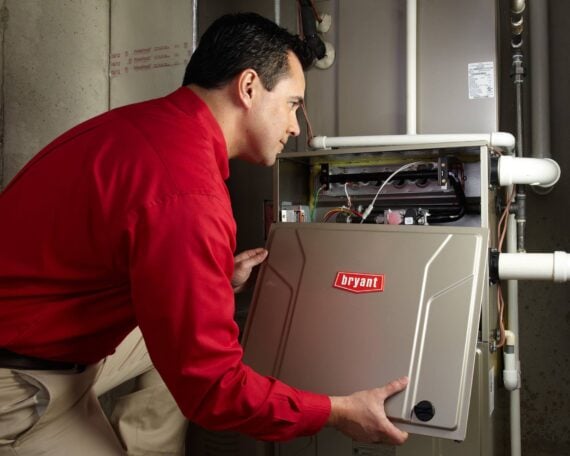
You may have never have heard of Day & Night, but Bryant and Carrier are well-known brands in the furnace world. All three of these furnace lines are made by United Technologies Corporation (UTC) and are virtually identical, with interchangeable parts — good news, because if you own a Day & Night furnace and it needs a part, it will be widely available. Carrier is the priciest of the three sibling brands, but the HVAC blogs we consulted say the price bump is just based on the Carrier name, not on any particular upgrades. While there’s not much information on Day & Night’s durability, Carrier and Bryant get decent reliability reviews, so buyers can probably expect Day & Night to perform similarly. Day & Night furnaces carry a 10-year parts warranty as well as a 1- to 10-year (depending upon the model) “No Hassle Replacement” warranty on “major components.” A Day & Night dealer can supply more model-specific details. Bryant also offers a 10-year parts warranty and varying, model-specific warranties on the heat exchanger that generally cover either 20 years or the life of the furnace — be sure to consult the installer or the manufacturer’s website for exact terms. Carrier offers a 10-year warranty on parts and a 20-year to lifetime warranty on the heat exchanger, depending upon the model. As with the others in this roundup, availability of these brands depends on location.
Trane/American Standard Review
Mid- to High-Priced Furnace Brands
Locate a Trane or American Standard dealer near you. Est. Prices: Starting around $1,275 for Trane; $1,350 for American Standard
There’s little difference between Trane and American Standard furnaces: They’re both made by Trane and share the same design and build characteristics; both get good reviews for reliability; and they cost about the same. Most of the HVAC blogs we consulted have nothing particularly bad to say about either of these companies, but most agree that the average consumer simply doesn’t need to spend so much on a furnace. (Both brands fall toward the bottom of the recommendation lists on a couple of the HVAC blogs we consulted, due to their high prices.) Still, if name recognition is important to you — and that is a factor for some — then Trane is a good, mostly mid-priced choice. The brand is also known for its CleanEffects air cleaning system, which can be paired with its furnaces. Its high-efficiency, low-pressure-drop filtering is geared toward allergy and asthma suffers and said to be more effective than even HEPA room filters — but, of course, this add-on comes at a premium, costing about $1,200 installed. The warranties on Trane and American Standard furnaces range from one to 10 years on parts (depending on whether the product is registered) and 20 years to lifetime on the heat exchanger. Both of these brands are widely available — another plus in a pinch.
York/Lennox Review
Think Twice Before Buying
Locate a York or Lennox dealer near you. Est. Prices: Starting around $780 for York; $1,410 for Lennox
York and Lennox are at the very bottom (York) and very top (Lennox) of the furnace price scale. While York’s low starting prices may appeal, the brand comes in dead last (based on reported failure rates) in Consumer Reports’ recent survey ranking 10 gas furnace brands for customer satisfaction. And upscale Lennox doesn’t rank much higher than its cheaper competitor. To be fair, Goodman and Amana furnaces appear in this lower bracket too, but with their budget prices and robust warranties (more comprehensive than York and equal to Lennox), those brands are probably a better bet. York offers a 5- to 10-year warranty on the heat exchanger and a 10-year warranty on parts. Lennox offers a 5- to 10-year warranty on parts and a 20-year to lifetime warranty on the heat exchanger, depending upon the model.
What We Considered
What we discovered in our research is that there isn’t a lot of difference among furnace brands. And experts agree that even a “cheap” furnace can be as good as a pricey furnace if it’s installed and maintained properly and comes with a decent warranty. All the prices listed here are for a basic, low-efficiency gas furnace — before installation. Expect a higher-efficiency model to add $500 to $1,000 to the price. Installation raises the total an additional $1,000 to $3,000, depending on the complexity of the install. Here we cover only natural gas furnaces, the most common type. In addition to full lines of of gas furnaces, at every efficiency rating, these manufacturers also make oil and electric models.
Choosing a Furnace
Most people don’t think about replacing their furnace until they wake up one day to a cold house. And, unless your furnace is very old and very inefficient, there’s probably no need for an upgrade. Still, if you have a furnace that’s at least 15 to 20 years old, a newer model can save you money in the long run in reduced energy costs. SmarterHouse has a chart that can help you determine if it’s time to replace your furnace. That site also features calculators for how much you can save on energy costs over the short and long term.
Of course, those are just guidelines. The efficiency of a new furnace relies on a number of factors, including the type of furnace you choose and your home’s overall energy efficiency. Your choice of furnace will also depend on where you live, as there are government standards that must be met for furnaces sold in different regions of the United States.
Installation
Experts agree that proper installation is much more crucial to furnace performance than the specific model you choose. Unless you are a heating, ventilation, and air conditioning professional yourself, you’ll need to work with a licensed HVAC contractor to buy and install a new furnace. The contractor usually purchases the furnace (at a wholesale price that’s marked up when they subsequently sell it to you), and their stock may be limited by the manufacturer(s) they represent. Some, but not all, HVAC professionals represent several manufacturers. Experts recommend getting at least three quotes from local contractors.
The installation generally costs more than the actual furnace. The national average is $4,238, according to HomeAdvisor. The cost may be higher or lower depending on the complexity of the install. Other factors that affect the cost are where you live, the brand and model of furnace you choose, the health of your existing ductwork, and the prevailing rates for labor.
Although putting in a new furnace is definitely not a DIY affair, we did read several anecdotal reports of consumers buying a furnace directly from a large home improvement store such as Home Depot or Lowe’s, and then working with the store to find an installer. Most of the furnaces available from these stores are relatively unknown brands. However, they’re likely made by one of the main manufacturers and just shipped with a generic label. So, as long as they come with a decent warranty, they might be worth a shot. Bargain shoppers who have gone this route seem to be largely happy with their experiences and say the savings were significant compared with going with a dedicated HVAC company.
Efficiency
If your furnace is an older model (most furnaces last for about 20 years), forget an apples-to-apples comparison when buying a new furnace. In part thanks to stricter energy regulations that have gone into effect in stages since 2013, furnaces are much more efficient than they used to be, so you probably can get by with a smaller unit than the one currently in your home. Again, it’s important to work with a reputable installer who will evaluate your home’s energy needs and help you choose a furnace that is the right size and efficiency for your home and your geographic area.
Furnace efficiency, measured in AFUEs, is fairly straightforward. A furnace with an AFUE rating of 82 converts 82 percent of its fuel into usable energy to heat your home. The remaining 15 percent is lost through the exhaust. The higher the AFUE rating, the more energy-efficient the furnace. In the area of the country designated by the Department of Energy as U.S. North, which encompasses 30 states, a newly installed furnace must have a minimum annual fuel utilization efficiency (AFUE) of 90 percent. In the 20 states designated as U.S. South, the minimum AFUE is 80 percent.
While furnaces sold in each region have to meet current minimum requirements, you can choose to install a higher-efficiency furnace than mandated. A rating of 90 percent AFUE or greater is required for U.S. South gas furnaces to qualify for Energy Star certification; a rating of 95 percent AFUE or greater is required for gas furnaces to earn an Energy Star label in the U.S. North. (There is talk of raising the base minimum AFUE to 92 percent nationally by 2021.) Higher-efficiency furnaces command higher prices up front, but they’re certified to be cost effective in the long term. In other words, the savings in energy costs, assuming a normal operating life span, will exceed the higher initial outlay.
But AFUE ratings don’t tell the full story: The specific type of furnace chosen makes a big difference in terms of both efficiency and comfort. A single-stage furnace basically turns off and on, running at full capacity while heating your home and shutting off when the desired temperature is reached. Two-stage furnaces are more efficient, running at low capacity to keep your home warm, and kicking into a higher stage when needed to bring the temperature up. They provide more even heating — you’re less likely to be hit with sudden blasts of hot air — and run more quietly than single-stage furnaces. Modulating furnaces have adjusting gas valves and variable-speed blowers, so that air can be heated and distributed optimally to maintain a desired temperature consistently. These are the most expensive but require even less fuel than two-stage furnaces, as they can adjust in precise increments and provide only as much or as little output as necessary.
Keep in mind: The more complex the furnace system, the more the initial installation will cost, and the more regular maintenance may be required. For example, most newer, high-efficiency models are sealed combustion condensing furnaces. Unlike conventional furnaces, which gather air from inside the home through front grates and vent exhaust through the chimney, a sealed combustion furnace requires a pipe to gather air from outside and another pipe for venting. These pipes typically pass through sidewalls rather than through a flue. There’s also a secondary heat exchanger, which converts as much of the combustible gas into usable energy as possible, and a condensate drain for the runoff that accumulates as exhaust passes through (conventional furnaces have only a single heat exchanger). It’s recommended that the drain hoses be cleaned and inspected regularly for cracks and leaks. Also, the upgrade from a conventional furnace to a condensing furnace may present problems with existing HVAC systems like water heaters (an “orphaned” water heater can actually release carbon monoxide into your home).
Work with your contractor to determine what type of furnace is compatible with your existing HVAC system. In addition to installation and any modification costs, a contractor should be able to give you an estimate, based on your specific situation, of the long-term savings that each type of system might provide.
Warranty
All furnaces include a warranty, and they’re all pretty similar: a 5- to 10-year parts warranty and a 20-year to lifetime warranty on the heat exchanger, depending upon the model. More expensive models have correspondingly better warranties.
The most important thing to know about furnace warranties is that you must register within a specific time frame to be eligible for full coverage. This is absolutely imperative, because if you don’t take the time to register, your warranty defaults to a “basic warranty” that can cut the coverage periods in half, or even more. For example, a 20-year heat-exchanger warranty might default to a 5-year warranty if the product isn’t registered. Again, work with your contractor to be sure you understand the details of the warranty coverage for the specific furnace brand and model you choose.
Ways to Save Money
First, try troubleshooting. If you are having issues with your current furnace, check to see if the problem is tangential to the furnace itself. A clogged filter, bad thermostat, or blown fuse may be the culprit. Do some sleuthing before you call a repair company or assume a replacement is immediately in order.
Get a second opinion. If you find out your furnace does need to be replaced, get a second opinion, especially if the furnace isn’t that old. While we hope most HVAC contractors are honest, there are bad apples in any group of professionals. Before spending thousands on a new furnace installation, be sure it’s something you truly need.
Check your ducts. Furnace efficiency (AFUE) ratings don’t tell the whole story about energy loss, because they don’t account for heat lost through ducts or pipes, which the Energy Department says can account for as much as 35 percent of total heating energy. Be sure the furnace installation (as well as each annual furnace maintenance visit) includes an inspection of your home’s duct work.
Conduct a home energy audit. Aside from the furnace and its peripherals, there might be other elements in your home that are contributing to higher energy costs. HVAC.com has some helpful guidelines for doing a home energy audit, and it might be worth the money to have a professional audit done. It can help pinpoint areas — both interior and exterior — where your home could be more energy efficient.