
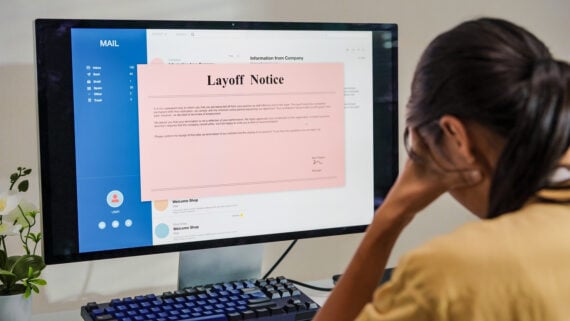
The farther away we get from the life the pandemic sucked out of us, that falser our sense of security grows. We think that because the doom days of 2020 layoffs are growing smaller in the rearview, we should be in a safe space with the economy.
But that’s not the case at all. According to a report by the U.S. economy consulting firm Challenger, Gray & Christmas, layoff announcements this year are the highest they’ve been since the 2020 pandemic.
So, How Bad Is It?

Statistically speaking, the layoff rates right now in the U.S. are impressively bleak. This is only the sixth time since 1993 (that’s 32 years — or this writer’s lifetime, folks) that the number of job cuts through November has exceeded 1.1 million. U.S.-based employers have axed a whopping 1,170,821 jobs this year as of the end of November, with more than 71,000 layoffs occurring in November alone.
The (dull) silver lining is that though these numbers are the worst they’ve been since 2020, they aren’t near as bad as they were in 2020, when job cuts soared to 2.3 million by November. Job cuts were also higher in October than November this year. We, do, however, have the highest monthly total for November since 2022.
What Industries Are Making the Most Job Cuts?

The Challenger report said that the industries impacted the most by layoffs last month included technology, food companies, and telecommunications firms.
Plenty of colossal companies have rolled out widespread layoffs this year, including Starbucks, Meta, Microsoft, UPS, Amazon, and, most recently Verizon, which announced plans to cut 13,000 jobs in November.
What Is Driving the Layoff Surge?

The technology sector leads job cuts in the U.S., increasing by around 17% over this time last year. We’ll give you one guess as to what’s filling the void left by these job vacancies. If you guessed AI: Ding ding ding! When announcing a job cut of 14,000, Amazon said it planned to lean on AI to boost efficiency. Robots can’t complain about wanting a raise, after all.
How Can You Tell If Your Job May Be at Risk?

A former HR professional (who said they’ve been through several rounds of layoffs) took to Reddit to share some of the subtle signs that might indicate your employer is preparing to cut jobs. Here are some of the key takeaways to consider:
Early Signs (3–6 months out)
- Sudden hiring freeze; vague talk about “efficiency” and “operational excellence.”
- Missed revenue targets or negative investor guidance.
- Big-name consultants show up.
- Leadership shakeups (new CEO/CFO).
- Budgets tighten: conferences canceled, perks cut, bonuses delayed.
- Culture messaging becomes overly polished or forced.
- Offices consolidated; facilities staff reduced.
Medium-Term Signs (1–3 months out)
- Your manager acts distant or vague; 1:1s get canceled.
- Major projects stall or reorganizations feel chaotic.
- Senior leaders quietly leave and aren’t replaced.
- Performance scrutiny increases; more documentation and PIPs.
- HR ramps up “check-ins,” surveys, and paperwork.
- Contractors and vendors cut; work shifts from innovation to maintenance.
- Company takes on debt, sells assets, or delays vendor payments.
Immediate Red Flags (2–4 weeks out)
- You’re asked to document processes or hand off work.
- Managers have secret meetings; conference rooms blocked off.
- HR schedules private, company-wide calendar holds.
- IT audits access or systems act glitchy.
- Leaders all show up on the same day when they normally don’t.
Final 48 Hours
- Early-morning “quick sync” invites.
- People pulled into conference rooms and not returning.
- Badge/VPN issues start before the meeting.
- Leaders visibly present and tense.
Polish your resumes. Lean into your network. Set boundaries. Review your severance packages. May the (work)force be with you.
Similar Stories on Cheapism
- Amazon, UPS Among Companies Announcing Mass Layoffs This Week — It’s a concerning sign for the economy’s health and an even bigger problem for workers being laid off right before the holidays.
- 42 Really Odd Jobs That Actually Exist (And Actually Pay Pretty Well) — We can’t believe some of these jobs actually exist.
- 19 Jobs That People Quit the Most, Ranked — Fact: Work enthusiasm is the lowest it’s been in a decade.