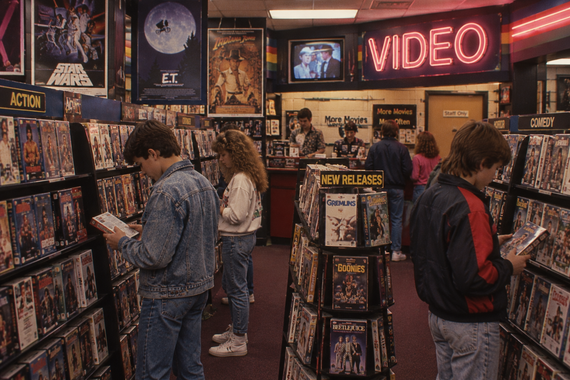

Growing up in the 70s and 80s meant spending a lot more time away from home, even for ordinary errands. Places people went in the 70s and 80s included shopping malls, roller rinks, record stores, arcades, bank branches, and photo counters, many of which doubled as social gathering spots. While plenty still exist, changes in how Americans spend their time and the rise of digital technology have made these once-routine destinations much less central to everyday life.
Shopping Malls

For many families, the mall wasn’t a quick shopping stop. It could take up an entire Saturday. There were department stores, fountains, food courts, movie theaters, and plenty of benches where parents waited while teenagers wandered around with friends. Food courts became fixtures of suburban mall culture by the 1980s. The mall didn’t vanish, but online shopping, department-store consolidation, overbuilding, and changing consumer habits have weakened many traditional enclosed malls.
Video Arcades

Before a game console could deliver an arcade-like experience in the living room, the newest games often meant feeding quarters into a cabinet somewhere else. Space Invaders, Pac-Man, Donkey Kong, and Galaga helped turn arcades into major hangouts around the turn of the 1980s, with machines also appearing in malls, pizza places, and convenience stores. The arcade boom cooled dramatically during the 1980s, while increasingly capable home systems eventually removed one of the biggest reasons to leave home to play.
Roller Rinks

Few places scream late ’70s and ’80s nostalgia quite like a roller rink. The combination of loud music, flashing lights, snack bars, birthday parties, couples skating, and the occasional spectacular fall made rinks as much about socializing as skating. Roller dancing became particularly associated with the 1970s and ’80s. The culture never disappeared, and skating has periodically enjoyed revivals, but numerous rinks closed during the 1990s and 2000s, leaving far fewer communities with the neighborhood rink experience older generations remember.
Drive-In Movie Theaters

Drive-ins were already past their numerical peak by the 1970s, but plenty of families and couples still spent evenings watching movies through a windshield. Some theaters offered double features, concession stands, playgrounds, and speakers that hooked onto the car window. More than 4,000 U.S. drive-ins operated around their late-1950s and early-1960s peak; only roughly 330 remain today. Rising land values, changing movie habits, and home video all contributed to their long decline.
Record Stores

Buying music once required considerably more effort than tapping a screen. Shoppers flipped through rows of LPs and cassettes, studied album covers, asked employees for recommendations, and eventually browsed the growing CD section. Tower Records, founded in 1960, became one of the era’s defining music retailers and was known as a place for music discovery as much as purchasing. Digital downloads, online retailers, big-box competition, and eventually streaming transformed that business, although vinyl’s revival has kept independent record shops very much alive.
Trending on Cheapism

Local Bowling Alleys

Bowling night once meant more than renting shoes and hoping not to throw a gutter ball. Neighborhood alleys hosted leagues, birthday parties, dates, and family nights, often with a snack bar, jukebox, arcade games, or lounge nearby. The biggest change has been the decline of league bowling. Industry figures cited by the Chicago Tribune showed league membership falling from about 9.7 million in 1980 to 1.7 million by 2014. Bowling survives, but many newer venues emphasize food, drinks, and entertainment rather than the old weekly-league culture.
Department Store Cafeterias and Lunch Counters

Shopping could work up an appetite, and decades ago there was a good chance you wouldn’t even have to leave the store to eat. Retail lunch counters and cafeterias served inexpensive meals, sandwiches, coffee, and desserts, making a shopping trip feel more like an outing. Woolworth’s luncheonettes became particularly famous gathering spaces, although Woolworth’s was technically a five-and-dime rather than a department store. As traditional retailers contracted or disappeared, many of their in-store dining rooms went with them.
Fotomats and Photo-Developing Shops

Taking vacation pictures used to require patience. After finishing a roll of film, you dropped it off, waited, and hoped nobody had blinked in every shot. Fotomat’s tiny drive-through kiosks were once an especially recognizable part of that routine. At its peak around 1980, the chain had more than 4,000 locations, according to AARP. One-hour processing later made its overnight model less competitive, while digital cameras and smartphones eventually eliminated the need to develop most everyday photos at all.
Sign up for our newsletter
Bank Branches

Depositing a paycheck once involved considerably more paper. Customers filled out deposit slips, stood in teller lines, and sometimes sent transactions whooshing through pneumatic tubes at the drive-through. ATMs, direct deposit, online banking, and smartphones steadily removed the need for many of those trips. By 2023, 48.3% of banked U.S. households said mobile banking was their primary way of accessing an account, while only 13.8% primarily used a bank teller. Branches still matter, especially for complicated transactions, but routine banking has largely moved elsewhere.
Travel Agencies

Planning a big trip once might begin with a chair across from a travel agent, surrounded by glossy brochures and destination posters. Agents could access reservation systems, fares, and schedules that were much harder for ordinary travelers to navigate independently. Today, airline websites, booking platforms, and other online tools let people research and reserve much of a trip themselves. Travel agents haven’t disappeared, though: the Bureau of Labor Statistics counted about 61,500 jobs in 2025 and notes that travelers still seek agents for personalized advice and help when problems arise.
Public Libraries for Everyday Research

Need to know the population of Brazil for tomorrow’s homework? Before search engines, the answer might require a trip to the library, an encyclopedia, a reference book, or help from a librarian. Card catalogs were once the standard tool for finding materials, and students could spend hours assembling information that now appears online in seconds. Libraries remain important and widely used, but their role has broadened considerably, with electronic resources, internet access, digital borrowing, classes, and community programs joining the shelves of books.
Neighborhood Social Clubs and Fraternal Halls

Elks lodges, Moose clubs, VFW halls, church halls, and other local organizations once filled calendars with bingo, fish fries, dances, card nights, fundraisers, and community dinners. They provided a reliable “third place” outside work and home, particularly for adults who belonged for years. Traditional civic and fraternal membership has declined over time, although the picture isn’t as simple as Americans giving up on community altogether; participation has shifted into different organizations and online spaces. What is harder to replace is the routine face-to-face gathering these halls once provided.