Somewhere between the old tip jar and the touchscreen at checkout, tipping culture in America became a lot more complicated. And apparently, I’m not the only one wondering what the rules are anymore.
I remember when I understood tipping.
At a restaurant, we used to look at the tax and roughly double it. Where I lived, that got you somewhere around 15%. If the service was great, you gave more, and if it wasn’t, you wanted to give less, but probably just stuck to the 15%. There were other people you usually tipped: bartenders, taxi drivers, hairdressers, hotel staff and food delivery people. I was never exactly eager to part with more money than necessary, but I considered myself a decent tipper then, and I still do.
But there were subtle rules. Or at least it felt like there were.
Then somebody turned an iPad around.
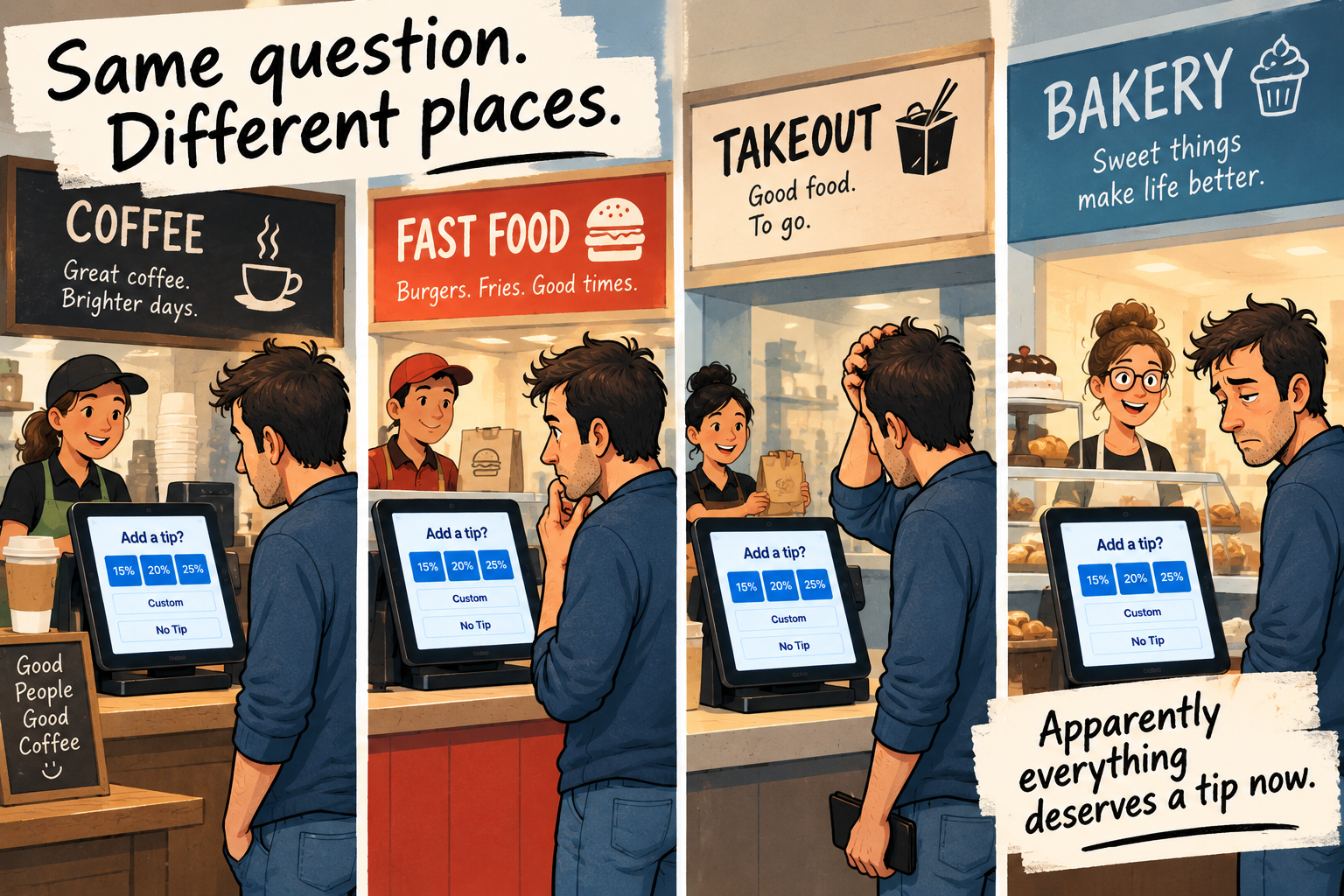
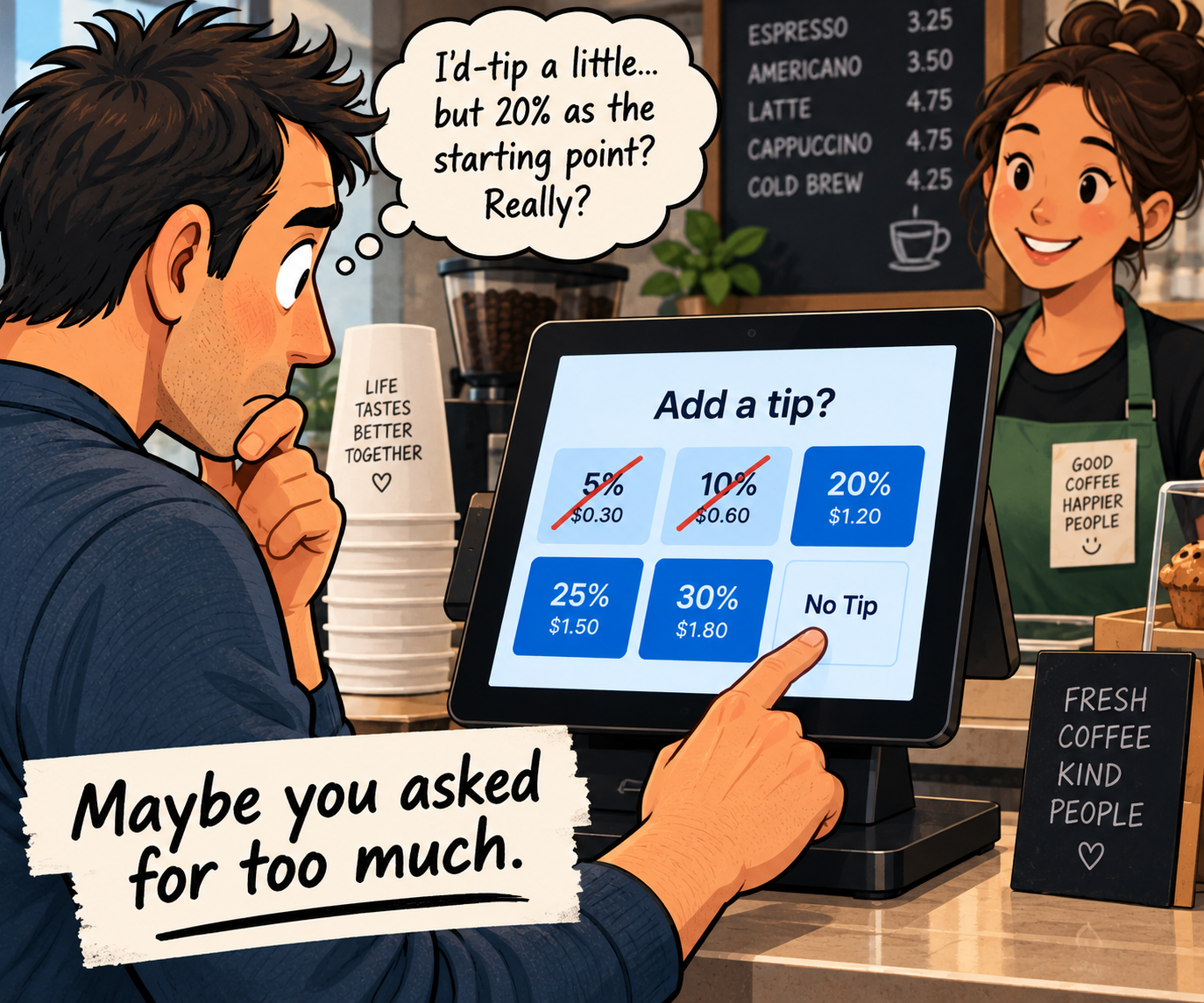
Now I buy a coffee, tap my card and suddenly I’m staring at three buttons asking whether I’d like to leave 20%, 25% or 30%. Sometimes it’s coffee. Sometimes it’s takeout. Sometimes somebody has taken something from behind a counter and handed it to me.
And I find myself wondering: Wait, am I supposed to tip here now? And 20%?
Apparently, I’m not the only one.
Tipping Culture Really Did Change
This isn’t just another case of me getting older and complaining that things aren’t the way they used to be. In a large 2023 survey, Pew Research Center found that 72% of Americans said tipping was expected in more places than it had been five years earlier.
That’s a remarkable change in a social custom over a pretty short period of time, particularly because the places where we’re being asked to tip aren’t necessarily places where we felt tipping was customary.
Pew found that 92% of people who eat at sit down restaurants say they always or often tip. That makes sense. At coffee shops, however, that number falls to just 25%, and at fast casual restaurants it’s only 12%.
Yet anyone who has bought a coffee lately knows there’s a pretty decent chance you’re going to encounter a screen asking for a tip, and a pretty significant one. The technology doesn’t seem particularly concerned with whether America has collectively agreed that this is a tipping situation. It simply gives us the option and waits for an answer.
The Tip Jar Learned How to Talk
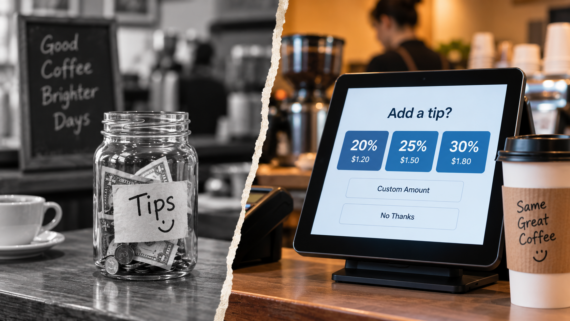
This might be the biggest change of all. The old tip jar sat on the counter. You could put a dollar in it, throw in your change or ignore it completely. It didn’t ask you any questions, suggest an appropriate contribution or wait for you to make a decision while the employee stood three feet away.
Modern payment technology does all of those things. And there’s a psychology to the whole thing that the old tip jar never had. The employee is standing right there, the screen is facing you, and you’re being asked to publicly choose between 20%, 25%, 30% or finding that little No Tip button. There’s a social pressure built into the transaction that I find genuinely uncomfortable. At this rate, the next software update will probably announce my choice out loud: “CUSTOMER HAS SELECTED NO TIP”. Maybe with a small siren to make sure everyone in line hears it.
And it doesn’t merely ask whether you’d like to tip. It can suggest how much you should tip, which is an important distinction.
Square, for example, allows businesses to turn tipping on and choose three custom percentages. Its standard Smart Tip setting currently shows $1, $2 or $3 on transactions below $10, and 15%, 20% or 25% once the transaction reaches $10. Businesses can change those amounts.
Toast similarly allows businesses to customize the suggested percentages customers see.
And I have another suspicion that I want to investigate as we go through this series. These are technology companies sitting on an enormous amount of transaction data. They can presumably see how often people tip, how much they tip and which suggested amounts they choose. I would be amazed if nobody is analyzing all of that. I would be amazed if nobody is analyzing all of that.
Are different tip screens being tested? Do businesses get data showing that customers tip more when the choices are 20%, 25% and 30% instead of 15%, 18% and 20%? Are merchants being encouraged to change those numbers based on what produces better results? I don’t know yet, and I don’t want to assume the answer. But I very much want to find out.
Because there’s a pretty powerful piece of human psychology working in their favor. If the lowest button says 20%, many of us aren’t going to stand there hunting for Custom Tip or No Tip while the employee and everyone behind us waits. We press the smallest button, move along and perhaps quietly resent the whole experience. If that’s happening millions of times a day, that little change in the screen could be worth a lot of money.
So when I encounter one of those screens starting at 20%, that’s not some new national tipping law I somehow missed. Someone chose those numbers, and I want to know a lot more about why they chose them and what happens when they do.
I’m Not Angry at the Person Behind the Counter
The easiest version of this story would be to complain about workers expecting tips for everything, but I don’t think that’s fair.
The person making my coffee didn’t invent the payment system. If that person is depending on tips to make a reasonable income, hitting No Tip to make some grand philosophical statement about tipping culture isn’t exactly sticking it to the system. It’s mostly affecting the person making my coffee.
What interests me much more is how the system changed around both of us.
When did businesses that historically paid workers without significant tip income start asking customers to tip? Who decides what percentages appear on the screen, and do higher suggested percentages actually make us tip more? Where does that money go, and have tips become a larger part of how some businesses compensate their employees?
There’s also a question I’ve wondered about for a long time: How much additional money did these screens generate simply by asking?
From a business perspective, that little screen may be brilliant. If adding a tip prompt gets customers to voluntarily add another 10%, 15% or 20% to thousands of transactions, that’s a significant amount of additional money being generated simply because the screen asked. Exactly who benefits from it, and by how much, is something I want to understand rather than assume.
Consumers May Be Starting to Push Back
There are signs that consumers are getting tired of all this. Bankrate’s 2025 tipping survey found that 41% of Americans believe tipping culture has gotten out of control, up from 35% a year earlier, while 38% said they’re annoyed by preset tip screens.
But here’s the number I find most interesting: 27% said they tip less or don’t tip at all when presented with a preset tip screen, compared with just 11% who said the screen makes them tip more.
So perhaps we’re learning to push back a little.
The social pressure of the screen works, but apparently it has limits. Ask me enough times for 20% in situations where I never used to tip at all, and eventually that little No Tip button starts looking a lot less intimidating.
I’ve noticed it in my own behavior. There are situations where I’d happily leave 5% or 10% to show some appreciation to the person helping me. But put 20% in front of me as the opening bid and sometimes I end up leaving nothing. That’s not really fair to the person behind the counter, who didn’t choose the screen or necessarily the percentages on it. But an overly aggressive ask can turn a willing tipper into a reluctant non tipper pretty quickly.
And that’s the irony. The technology may be getting very good at asking us for bigger tips while simultaneously making some of us much better at saying no.
So I’m Going Down the Tipping Rabbit Hole
Over the next several weeks, I’m going to try to figure this out, and not because I want to stop tipping. I want to understand how we got from leaving 15% after dinner to being presented with a 20% button when buying something at a counter.
I want to know who chooses those numbers and what happens when they choose higher ones. I want to know how much money this technology generates, who gets it and whether it has changed how businesses pay their employees. I want to look at Uber, where one of the original attractions was getting out of the car without having to deal with payment or tipping, and ask how we ended up being asked to supplement driver income ourselves.
I also want to understand why America handles tipping so differently from much of the rest of the world and, eventually, answer the question I now find myself asking surprisingly often:
Am I actually supposed to tip here?
Because at this rate, I’m half expecting the self checkout machine at the supermarket to ask me for 20%. And considering I did all the work, I’m keeping it.