
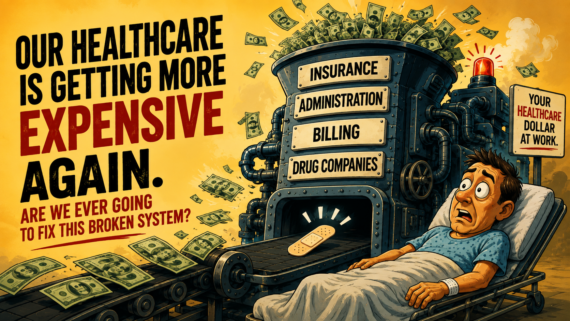
Another huge increase is coming. Are we ever going to fix this broken system?
Another year, another reminder that US healthcare costs apparently haven’t finished getting more expensive.
Aon is projecting that employer healthcare costs will rise another 9.5% in 2027, pushing the average cost above $19,000 per employee, according to Reuters’ report. This would be the fourth straight year of near-double-digit increases, driven this time by all sorts of line items I am not even bothering sharing.
At this point, an announcement that healthcare is getting significantly more expensive feels less like news and more like a subscription renewal notice. Of course it went up. It always goes up.
And yes, like other things it is not a surprise that healthcare gets more expensive, everything does. These are the rules of basic economy. But what makes this particularly irritating is that American healthcare isn’t expensive simply because healthcare is expensive.
It’s expensive because we have somehow managed to make healthcare exceptionally expensive here.
US Healthcare Costs: Paying More, Getting Less. Impressive.
That would at least make sense.
If Americans were going to the doctor twice as often, spending twice as many nights in hospitals and generally consuming healthcare like it’s an all-you-can-eat buffet, maybe we’d understand why we’re paying so much more.
Except we’re not.
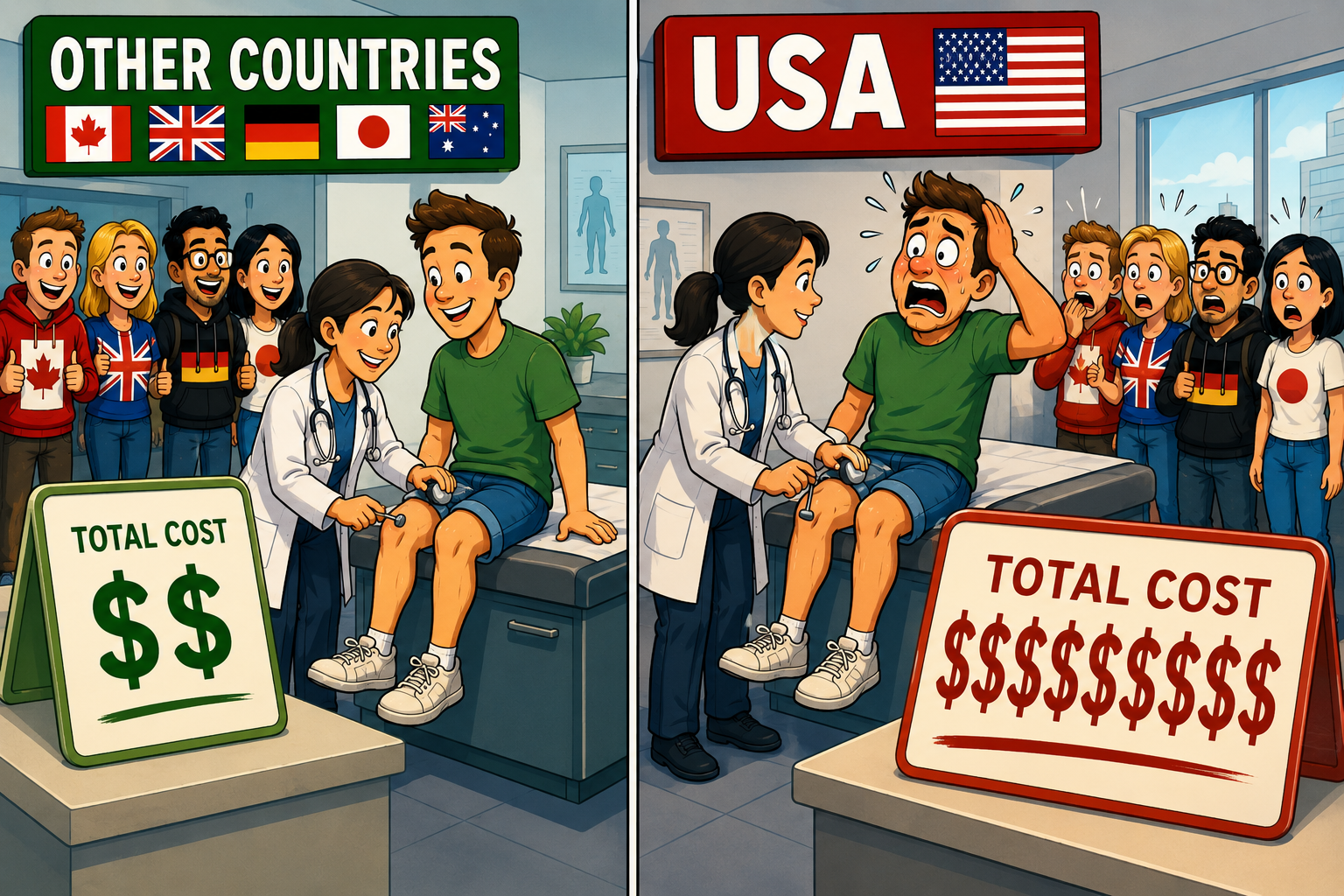
KFF’s international comparison found that the U.S. spends nearly twice as much per person on healthcare as comparable wealthy countries ($13,432 versus $7,393 as of 2024), while Americans generally use less healthcare. We have fewer doctor visits than people in many peer countries, shorter hospital stays and lower use of several common procedures.
So we’ve achieved something genuinely impressive: we figured out how to get less healthcare and pay dramatically more for it.
And this is where my patience starts running out, because we’re not talking about some mysterious global force like the price of oil. Other wealthy countries have sick people too. They have hospitals, doctors, expensive equipment, pharmaceutical companies and aging populations.
They just don’t have our bill.
We’re Paying a Lot of People Who Aren’t Treating Anyone
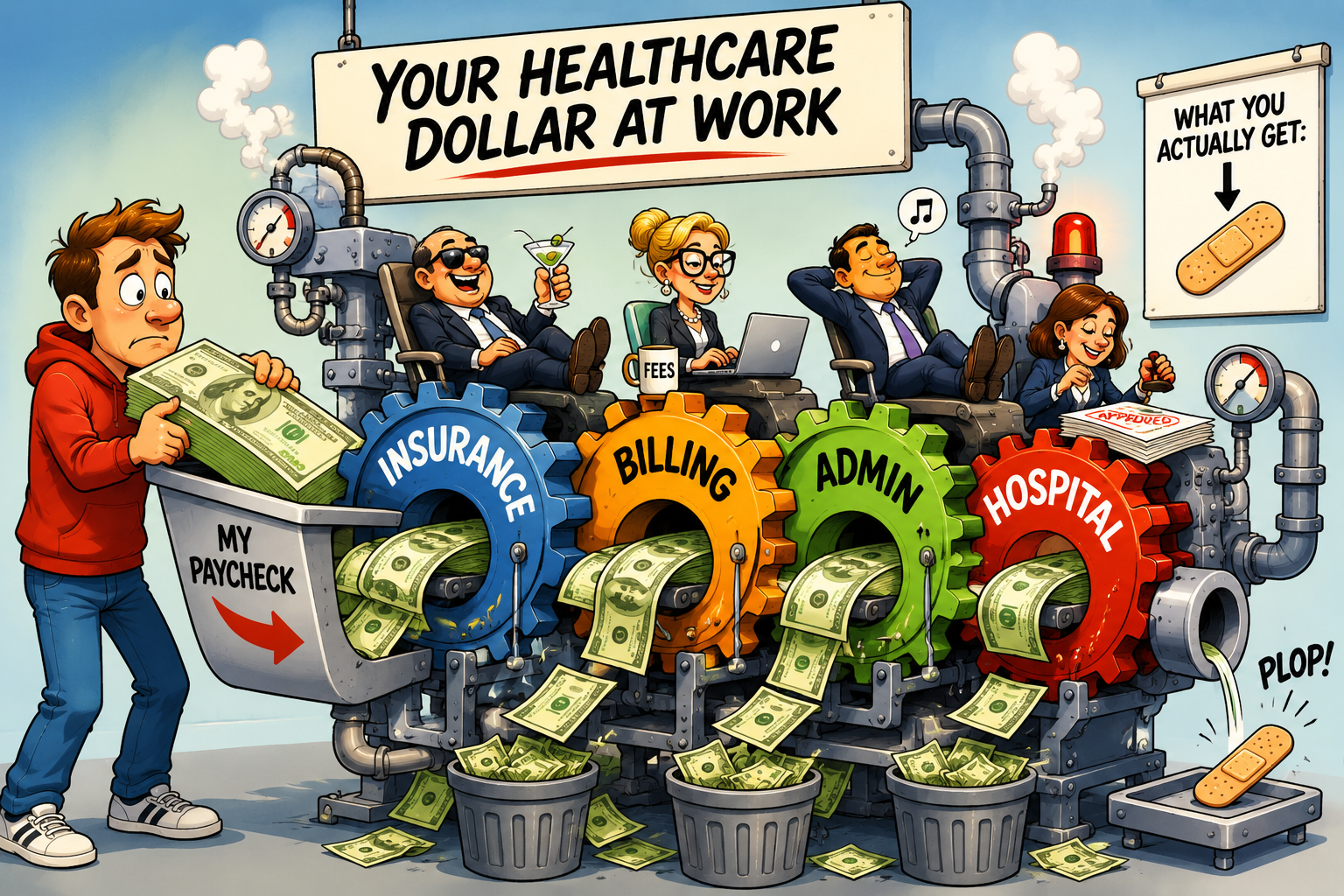
America didn’t just build a healthcare system. We built an enormous industry around figuring out who is going to pay for the healthcare system.
We have insurance companies negotiating with hospitals, hospitals negotiating with insurance companies, employer benefits departments dealing with insurers, billing departments dealing with insurers, claims processors, networks, pharmacy benefit managers, prior authorizations and an impressive collection of people whose involvement in my healthcare appears to be mostly financial.
Eventually, hopefully, somebody gets around to looking at my knee.
According to KFF’s international comparison of health systems, the U.S. spends about $1,078 per person just on health-system administration. And here’s my favorite part: that number doesn’t even include administrative spending inside hospitals and doctors’ offices.
We’ve built layers upon layers of organizations and departments whose job is essentially to figure out how money moves between all the other organizations and departments. Then we wonder why moving the money costs so much money.
Oh, and the Actual Healthcare Costs More Too
The bureaucracy helps explain why US healthcare costs are so high, but we can’t blame everything on paperwork.
The much bigger problem is considerably simpler: we pay more for the actual medical care.
KFF’s analysis found that almost 80% of the spending difference between America and comparable wealthy countries came from inpatient and outpatient care. Americans were spending thousands more per person on those services, and the evidence consistently points toward higher prices rather than dramatically greater use.
Same human body. Same MRI machine. Same basic idea of a hospital. Much more impressive invoice.
And there’s also the reality of healthcare pricing: we usually have no idea what we’re buying until after we’ve bought it.
Nobody arrives at the ER with chest pain and says, “$14,000? Let me shop around.”
You need care, you get care, and somewhere down the road a bill shows up explaining what this adventure apparently cost. Good luck comparison-shopping your appendectomy.
And Then There Are the Drugs
Prescription drugs aren’t the biggest driver of US healthcare costs, but they’re an especially annoying example of the same problem.
KFF found that Americans spent $1,635 per person on prescription and over-the-counter drugs in 2021, compared with $944 in comparable countries. Many of the same retail prescription drugs simply cost more here.
And yes, America has finally started doing more negotiating. Medicare’s first negotiated prices for 10 high-spending drugs took effect this year.
Progress!
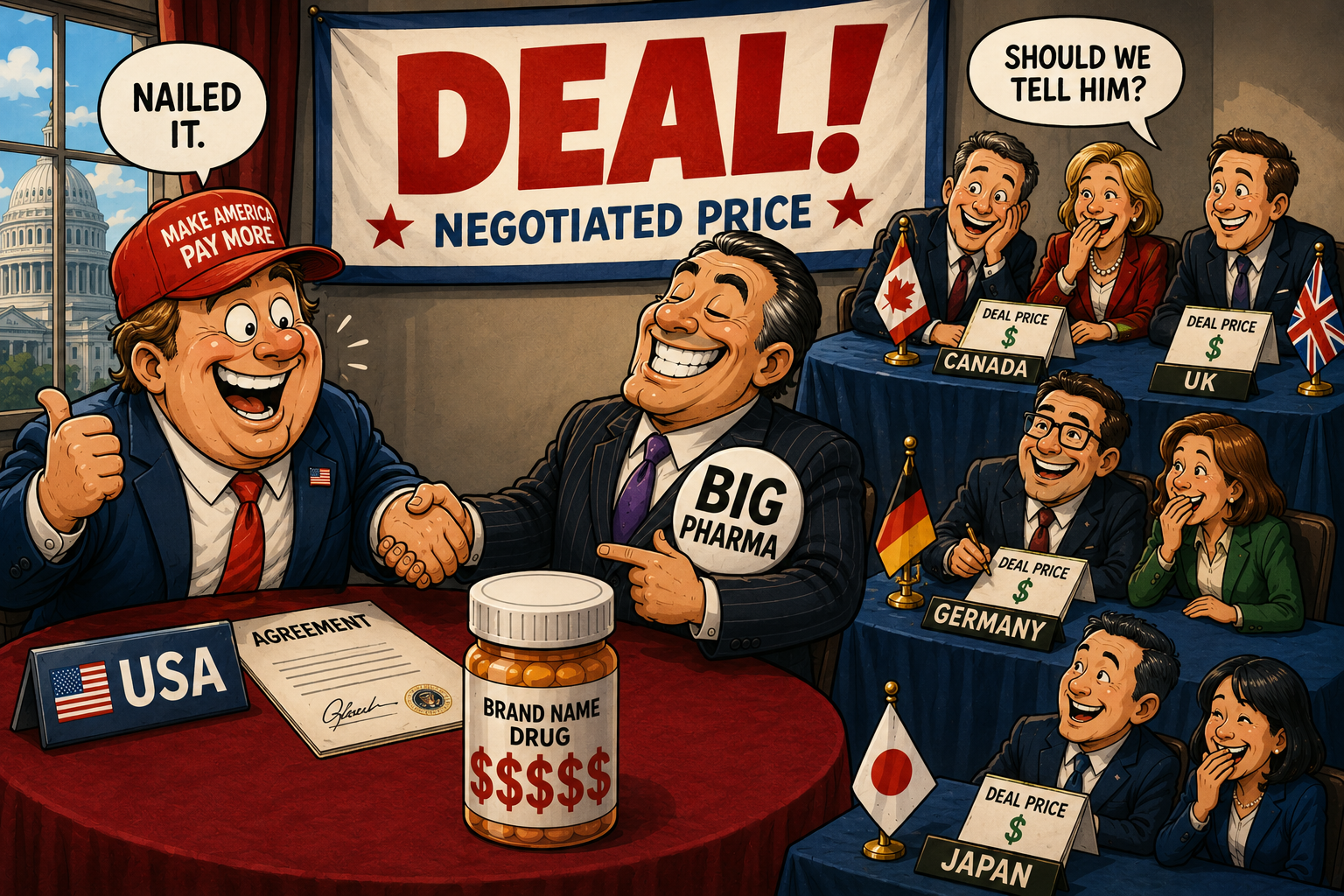
Except when KFF compared those negotiated prices with prices in 11 other wealthy countries, our newly negotiated prices were still 78% higher on average than the country with the next-highest price.
Some negotiators.
We finally walked into the dealership and said, We’re not paying sticker price.
We negotiated, went back and forth on price, shook hands, and apparently still managed to get a price that is higher than everybody else.
Are We Ever Going to Fix This?
I’m not a healthcare economist, and I’m definitely not going to pretend I know how to redesign American healthcare. This is not my job and people considerably smarter than me should be handling this.
But that’s also becoming a pretty convenient way to avoid stating the obvious.
We all know Americans pay far more for healthcare than people in comparable wealthy countries. We know we’re not getting twice as much healthcare for that money. We know our administrative machinery is unusually expensive. We know medical services cost more here, and we know many drugs cost more here.
These aren’t exactly newly discovered mysteries.
And now another report arrives telling us US healthcare costs are expected to keep climbing, with employer healthcare costs projected to jump another 9.5% next year.
We built a system where hospitals can charge enormous prices, drugs routinely cost more than they do elsewhere, insurance adds another huge layer of complexity, and then we spend even more money administering the complicated process of figuring out who’s supposed to pay for all of it.
At some point this needs to stop. I get that we built a monster that is hard to dismantle, but this is not sustainable anymore and needs to be taken care of.
Until then, I’m curious: What part of the American healthcare system drives you most insane? Premiums? Deductibles? Drug prices? Prior authorization? Fighting with insurance?