
For plenty of kids and teenagers growing up in the 1980s, the mall wasn’t just where you went when you needed a new pair of jeans. It was where you met friends, ate pizza, played arcade games, caught a movie, and wandered around for hours with absolutely no intention of buying anything.
And while every mall had its own personality, they also had a strangely consistent look. There were fountains surrounded by indoor plants, cavernous atriums filled with natural light, department stores anchoring either end, and food courts where everything seemed to arrive on an orange or brown plastic tray.
Not every American mall had every feature below, of course, but put them all together and you’ve got a pretty convincing time capsule of a Saturday afternoon at the mall in the 1980s.
A Giant Indoor Fountain

Before malls started squeezing kiosks and pop-up shops into every available patch of floor, prime real estate could be occupied by something as wonderfully impractical as a giant fountain. Usually surrounded by tile, benches, and plenty of indoor greenery, these fountains served as both decoration and unofficial meeting spots. Kids tossed in coins, parents rested nearby, and the sound of splashing water could announce that you’d reached center court before you even saw it. Many eventually disappeared as malls renovated and found more profitable uses for the space.
A Sunken Conversation Pit or Seating Area

Apparently, malls once expected people to sit down without ordering a $7 coffee first. Built-in benches, carpeted lounge areas, molded planters, and even sunken seating zones gave shoppers plenty of places to take a break. Teenagers could claim one while waiting for friends, and exhausted parents could recover from an afternoon of shopping. These spaces were part of what made malls feel less like collections of stores and more like indoor public squares where lingering was practically encouraged.
Huge Planters Full of Indoor Trees

The ’80s mall loved bringing the outdoors inside — minus the weather, bugs, and actual fresh air. Ficus trees, palms, shrubs, and other greenery sprouted from enormous planters throughout shopping corridors and atriums, often alongside fountains and seating areas. Some malls went even further with ponds and elaborate indoor gardens. Combined with soaring skylights, all that greenery helped make a climate-controlled shopping center feel surprisingly lush.
A Glass Elevator

Taking the escalator might have been quicker, but where was the fun in that? In a multilevel mall, a glass elevator rising through the central atrium could feel like a futuristic attraction all by itself. Mirrored surfaces, shiny brass trim, and transparent walls let riders watch stores and shoppers slide past as they traveled between floors. For kids especially, convincing a parent to take the elevator could be part of the mall entertainment.
Long Escalators in the Center Court

Few things said “big mall” quite like a pair of long escalators cutting through a massive open atrium. They weren’t simply a way to get upstairs. They were landmarks, people-watching platforms, and opportunities to lean over the railing and survey the fountain, shoppers, or food court below. The wide-open design also made malls feel enormous, especially when you were a kid being dragged through one for what seemed like an entire day.
Trending on Cheapism


A Food Court Full of Plastic Trays

The food court helped transform shopping into an all-afternoon activity. Families and groups of teenagers could split up for pizza, burgers, fries, pretzels, or Chinese-American combo plates and then reconvene at rows of communal tables. And somehow, much of it seemed to arrive on a sturdy orange or brown plastic tray. Add an oversized soda and the challenge of finding an empty table on a Saturday afternoon, and you’ve got one of the defining mall experiences of the era.
A Movie Theater Attached to the Mall

Why leave the mall when you could turn a shopping trip into dinner and a movie? Attached and nearby multiplexes became natural extensions of mall life, particularly for teenagers looking for somewhere to spend a Friday night. You’d check the showtimes posted outside, buy a ticket, and disappear into an auditorium that was often much smaller than today’s stadium-style theaters. Best of all, the entire evening could happen without anyone needing to move the car.
A Video Arcade

You could often hear the arcade before you could see it. Rows of glowing cabinets filled the room with electronic beeps, explosions, music, and the occasional frustrated teenager. During the video-game boom, machines such as Pac-Man, Galaga, and Donkey Kong could turn a pocketful of quarters into an hour of entertainment — or disappear those quarters in about 10 minutes. Some arcades used tokens instead, which only added another machine you had to visit before the games could begin.
Sign up for our newsletter
A Photo Booth

Long before everyone carried a camera in their pocket, the mall photo booth offered something that felt almost magical: pictures you could take and hold within minutes. Friends and couples would squeeze behind the curtain, make increasingly ridiculous faces, and wait for a strip of tiny photos to emerge. Trying to cram four teenagers into a booth clearly designed for two was half the experience.
A Huge Department Store at Each End

You might not have known the phrase “anchor store,” but you definitely knew where the big department stores were. Traditional malls were often built around massive retailers at opposite ends, encouraging shoppers to pass dozens of smaller stores while walking from one anchor to another. Depending on where you lived, that could mean Sears, JCPenney, Macy’s, Montgomery Ward, or a beloved regional chain. They also served another crucial function: helping you remember which side of the enormous parking lot contained the family car.
A Record Store Blasting Music

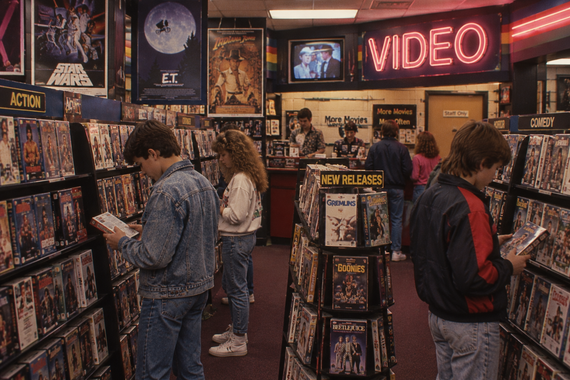
For music-obsessed teenagers, the record store wasn’t just another shopping stop. It was somewhere to browse albums and cassettes, inspect new releases, stare at posters, and potentially spend your entire allowance. Walls and racks packed with cassette cases made browsing a physical activity, and music spilling into the corridor could announce the store before you reached the entrance. Buying music was social, too — you went with friends, compared tastes, and left carrying an album you couldn’t immediately stream on the ride home.
A Smoke-Filled Restaurant or Seating Area

Here’s one part of the ’80s mall experience that probably inspires less nostalgia. Smoking indoors remained common enough that shoppers could encounter cigarette smoke in restaurants, food areas, and other parts of a mall. Some benches and tables even incorporated ashtrays, something that would look wildly out of place in most American shopping centers today. Designated smoking sections and increasingly strict smoking rules would gradually change that landscape, but for many ’80s shoppers, cigarette smoke was simply part of being out in public.
A Directory Map You Actually Had to Read

Getting lost at the mall once required more than waiting for your phone to recalculate the route. Giant directory maps — often illuminated from behind — listed stores alongside a maze of corridors and numbers. The first challenge was finding the little “YOU ARE HERE” marker. The second was figuring out how that information could possibly help you get where you wanted to go. Even after studying the map for several minutes, there was a decent chance you’d start walking in the wrong direction.
A Pay Phone Bank

Before a text reading “come pick me up” could summon a parent to the parking lot, there was the pay phone. Banks of phones near mall entrances, restrooms, and food courts gave teenagers a lifeline home after hours spent wandering with friends. You needed coins, someone actually had to answer the phone on the other end, and changing your pickup plans could become a minor logistical operation. Collect calls offered another option when your pockets were empty — assuming someone at home accepted the charges.
Groups of Teenagers Wandering Around With No Real Plan

The most important feature of the ’80s mall wasn’t architectural at all. It was the packs of teenagers roaming its corridors with a few dollars, a pickup time, and no particular destination. They browsed records, played arcade games, shared fries, looked for friends, and walked endless laps without necessarily buying much of anything. For teenagers who couldn’t drive yet, the mall offered something especially valuable: a semi-independent place to socialize away from home. All those fountains, benches, arcades, theaters, and food courts mattered because they gave people a reason to stay.
The classic 1980s mall wasn’t designed simply to get shoppers in and out with their purchases. It gave them places to eat, sit, play, watch movies, meet friends, and waste an entire afternoon. Technology, changing smoking rules, redevelopment, and the struggles of traditional retail have made plenty of these features disappear or evolve. But for anyone who remembers being dropped off with a few bucks and instructions to meet back at the entrance at 5, the combination of indoor fountains, arcade noise, food-court trays, and wandering teenagers can still bring back the whole experience.