
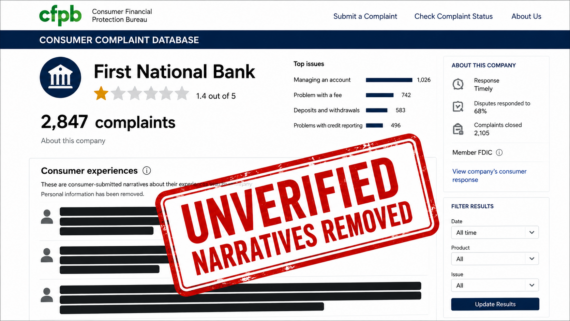
The CFPB complaint database has always had something in common with Amazon reviews: you shouldn’t necessarily believe everything you read there.
There’s a giant government database where Americans complain about their banks, credit cards, mortgages, debt collectors and other financial companies. And until now, one of the only interesting things about it was that you could actually read what some of those consumers said about those institutions.
The Consumer Financial Protection Bureau (CFPB) would remove personal information, and consumers had to opt in before their written stories could be made public. The complaints weren’t verified, and the database made that clear, but you could still see the actual experience behind a complaint rather than just a category on a spreadsheet.
As of last Friday, that’s changing.
The CFPB announced that it will stop publishing consumer complaint narratives, along with associated data visualizations. The Consumer Complaint Database itself isn’t going away, and consumers can still file complaints, but we lose the ability to read the consumer’s version of what actually happened.
You can read the CFPB’s announcement here: The CFPB to Cease Discretionary Publication of Complaint Narratives and Visualizations.
Would Amazon Reviews Work the Same Way?
To be fair, the CFPB has a point. These are complaints, not proven facts. Someone can accuse a bank of doing something terrible, and that doesn’t mean the bank actually did it. Publishing that accusation on a federal government website can give it a credibility it may not deserve.
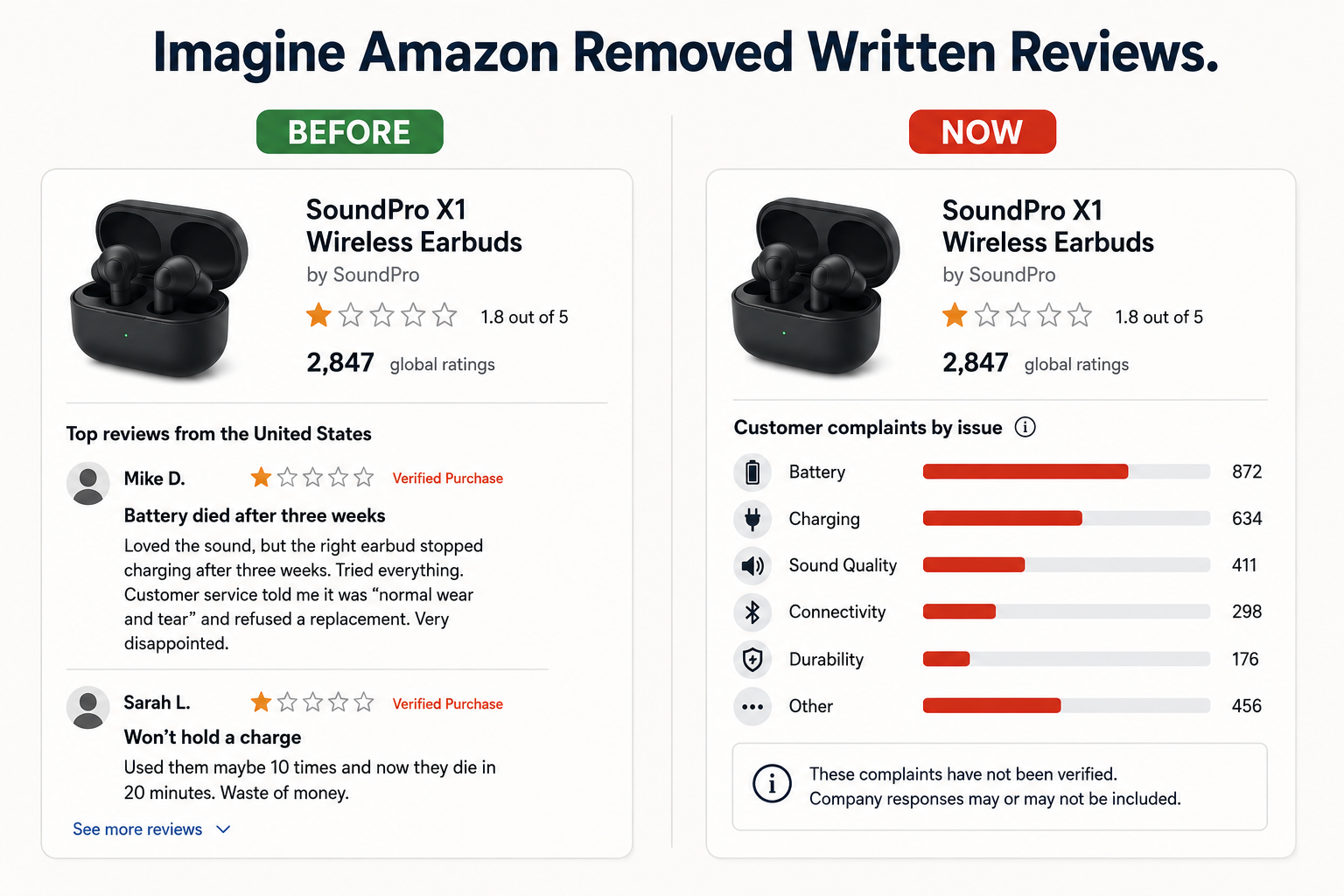
But imagine Amazon announced tomorrow that customer reviews are unreliable because nobody independently verifies what reviewers write. So from now on, written reviews are gone.
Instead, Amazon tells you that a product received 2,847 complaints and gives you a breakdown:
Battery: 634 complaints. Shipping: 411. Quality: 872. Other: 930.
Technically, you still have plenty of data. But do you have the same information?
If I’m considering opening an account with a bank and discover 3,000 complaints about it, I don’t necessarily know what that means. A huge bank has millions of customers. Maybe 3,000 complaints isn’t particularly remarkable.
But if I start reading those complaints and see person after person describing the same unusual problem, that’s useful information.
It doesn’t prove the bank did anything wrong, and it doesn’t mean every person is telling the whole story, but it gives me something a complaint count can’t: a pattern I can recognize for myself.
Granted, The CFPB Complaint Database Does Have a Real Problem
To be fair, every review system has a problem. People are more likely to write when something goes wrong. Reviews can be exaggerated, unreasonable, fake, manipulated or increasingly generated with AI.
CFPB’s database has an even bigger problem: it’s literally a complaint database, and it has become enormous.
American Banker reported that the CFPB received roughly 6.6 million complaints in 2025, up from 3.2 million in 2024 and 1.6 million in 2023. The system has also faced duplicate submissions, AI-generated complaints and alleged manipulation by credit-repair companies and social-media influencers. (americanbanker.com)
So there is a legitimate challenge here. Nobody contacts the federal government to report that their credit card worked perfectly this month. If a bank has 5 million happy customers and 5,000 furious ones, the database gives you a front row seat to the 5,000 furious ones. Read enough of those stories and you could easily come away thinking the company is a disaster, even if 99.9% of its customers never had a problem.
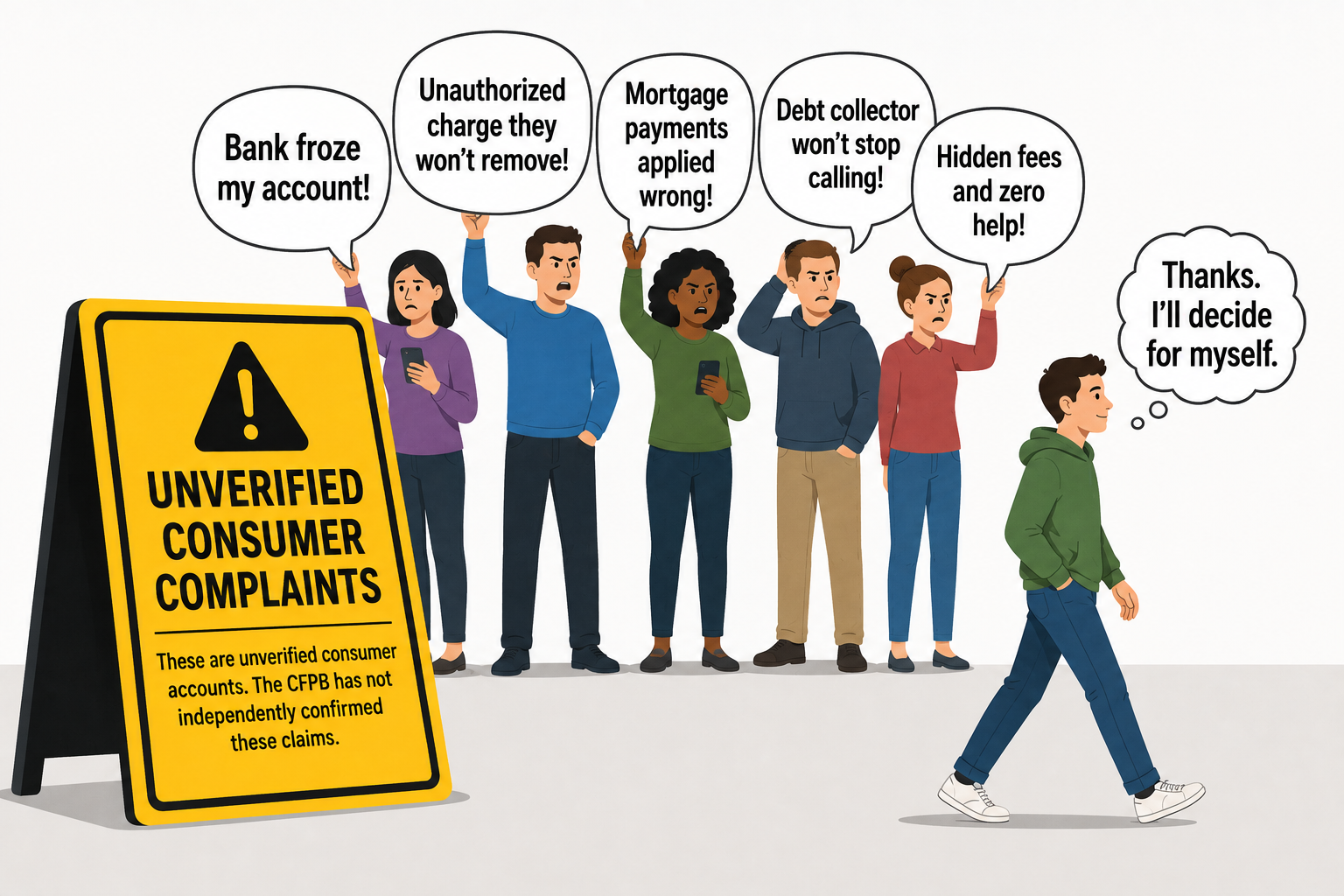
But while I concede the CFPB complaint database has an information quality problem, I’d still rather know I’m standing in a room full of unhappy customers and be warned that I’m only hearing from the unhappy customers.
We already navigate unverified information constantly. I read hotel reviews before booking a room, restaurant reviews before making a reservation, and I’ve probably spent an embarrassing amount of time reading what strangers think about a $20 product before ordering it.
I know some reviewers are unreasonable, some may be fake. I know I’m only hearing about one person’s experience. I just still want to read them.
Financial products aren’t exactly trivial purchases. A problem with a mortgage, credit card or bank account can be considerably more consequential than buying a lousy phone charger.
I also want to remind all of us that those companies make it their business to know an extraordinary amount about us before deciding whether they gracefully decide to take our money. Our credit history, income, debts, payment behavior and risk profile can all become part of the equation. I don’t think it’s unreasonable to want to know a little more about them too.
So I’m curious where everyone else lands.
Would you rather be able to read unverified consumer complaints with a clear warning attached, or do you think the CFPB is right to stop publishing them?
Leave your thoughts in the comments…