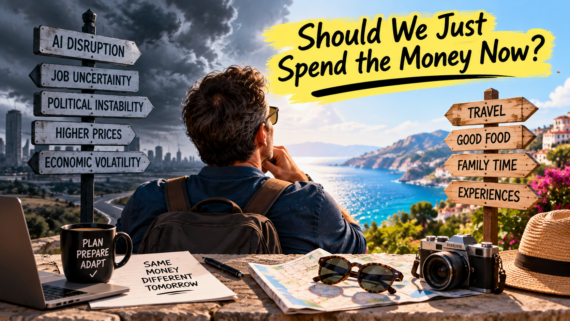
Americans are increasingly pessimistic about the economy and the future. Strangely enough, we also can’t seem to stop spending.
I’ve become increasingly pessimistic about what the next five or ten years are going to look like. And yet, that hasn’t made me more conservative with my money. If anything, I’m a little looser with it.
That’s a conscious choice. I’m still saving, still thinking about the future and certainly not spending everything I’ve got. I’m just less inclined to hold back on things I can comfortably afford today. Take the trip. Go out for dinner. Do something with the kids. Enjoy it while I can.
Part of that is simply being over 50. I’m watching way too many YouTube videos telling me that there’s a window when I have the health, income and freedom to do certain things, and I should be saving all of that for some theoretical retirement.
But part of it is also how I see the next decade. Between political instability around the world, the potential disruption AI could bring to jobs and whatever else we haven’t thought of yet, I’m pretty convinced we’re in for a rocky stretch. Not the end of civilization. Just enough uncertainty that I don’t automatically assume my life five or ten years from now will offer the same freedom I have today.
If my income eventually becomes unstable, I’ll cut back because I’ll have to. Until then, I’m not sure I see the benefit of behaving as though it already happened.
That’s my calculation. It certainly doesn’t mean that’s what the rest of America is doing. But it made me particularly curious when I saw two numbers that seem to have no business sitting next to each other.
Americans are feeling increasingly lousy about the future. And we keep spending money.
We Feel Terrible. We’re Spending Anyway.
The latest numbers are almost comically contradictory.
The University of Michigan’s preliminary September reading of consumer sentiment fell to 47.8, down 7.5% in just one month and 13.2% from a year ago. Expectations for personal finances and business conditions over the coming year also deteriorated.
Then came the government’s latest report on what Americans are actually doing with their money. We go shopping…
Retail and food service sales jumped 1.2% in August and were 6% higher than a year earlier, reaching $773.9 billion. Even after taking gas stations out of the equation, sales increased 1.1% for the month.
So apparently we can simultaneously believe things are heading in the wrong direction and decide we’d still like to buy stuff.
I’m starting to wonder whether those two things are as contradictory as they sound.

Maybe Pessimism Doesn’t Always Make Us Save
The traditional financial response to uncertainty is pretty obvious: save more.
If you’re worried about your job, the economy or what comes next, having more money in the bank seems like an excellent idea. And for plenty of Americans, that’s undoubtedly what uncertainty means.
But there’s another possible reaction. At some point, uncertainty can also make postponing everything feel less attractive.
There is already a fashionable name for the more extreme version of this: Doom Spending. The idea is that people anxious about the future spend money today because saving toward an increasingly uncertain tomorrow can feel pointless.
I’m not convinced that explains what’s happening here, and it certainly doesn’t explain everyone who is still spending. But I understand the impulse behind it.
For me, it’s not “the world is ending, so buy the Porsche.” It’s much more mundane. If I can comfortably afford a trip today, why am I automatically assuming I’d be better off postponing it for five years?
Maybe I’ll have more money then, maybe I won’t. Maybe I’ll have the money but not the health. Maybe my income will change. Maybe the economy will. Maybe the trip will cost twice as much. Or maybe everything will be perfectly fine and I’ll wonder why I worried so much in the first place.
Nobody knows.
And perhaps after enough years of uncertainty, some people simply become a little less interested in waiting for the perfect moment to enjoy their money.
There’s a Catch in the Consumer Spending Numbers
Before we declare that America has collectively decided to live for today, there’s an important problem with the numbers.
We’re not all spending the same way.
Research published this year by the Federal Reserve Bank of New York found that recent growth in retail spending has been driven disproportionately by households earning more than $125,000 a year. The researchers describe an increasingly uneven economy in which higher income households are accounting for an outsized share of consumption growth.
That distinction matters.
If housing, groceries, insurance and utilities are consuming most of your paycheck, uncertainty about the future probably isn’t inspiring you to book another vacation. You’re trying to make the numbers work this month.
Other consumer research points in that direction too. PwC found 84% of consumers were taking some action to manage their finances more cautiously, while 39% said they were cutting discretionary spending.
So the big national spending number can hide very different realities.
Some households are pulling back. Some are paying more simply because things cost more. Some are trading down or hunting for deals. And households with more disposable income can continue spending enough to make the overall numbers look surprisingly healthy.
Which makes the question more interesting, not less.
If the people with the ability to spend are also worried about the future, why are they still doing it?
Maybe Consumer Spending Is Just Changing
There’s another possibility that interests me.
Maybe uncertainty isn’t simply changing how much some of us spend. Maybe it’s changing what feels worth spending money on.
I’m increasingly willing to spend on experiences. A great dinner, a weekend away, a concert or something else I really want to do feels more valuable to me than simply watching that money accumulate in an account. That’s not necessarily about age. It’s about deciding that enjoying some of the money I’ve earned has value too.
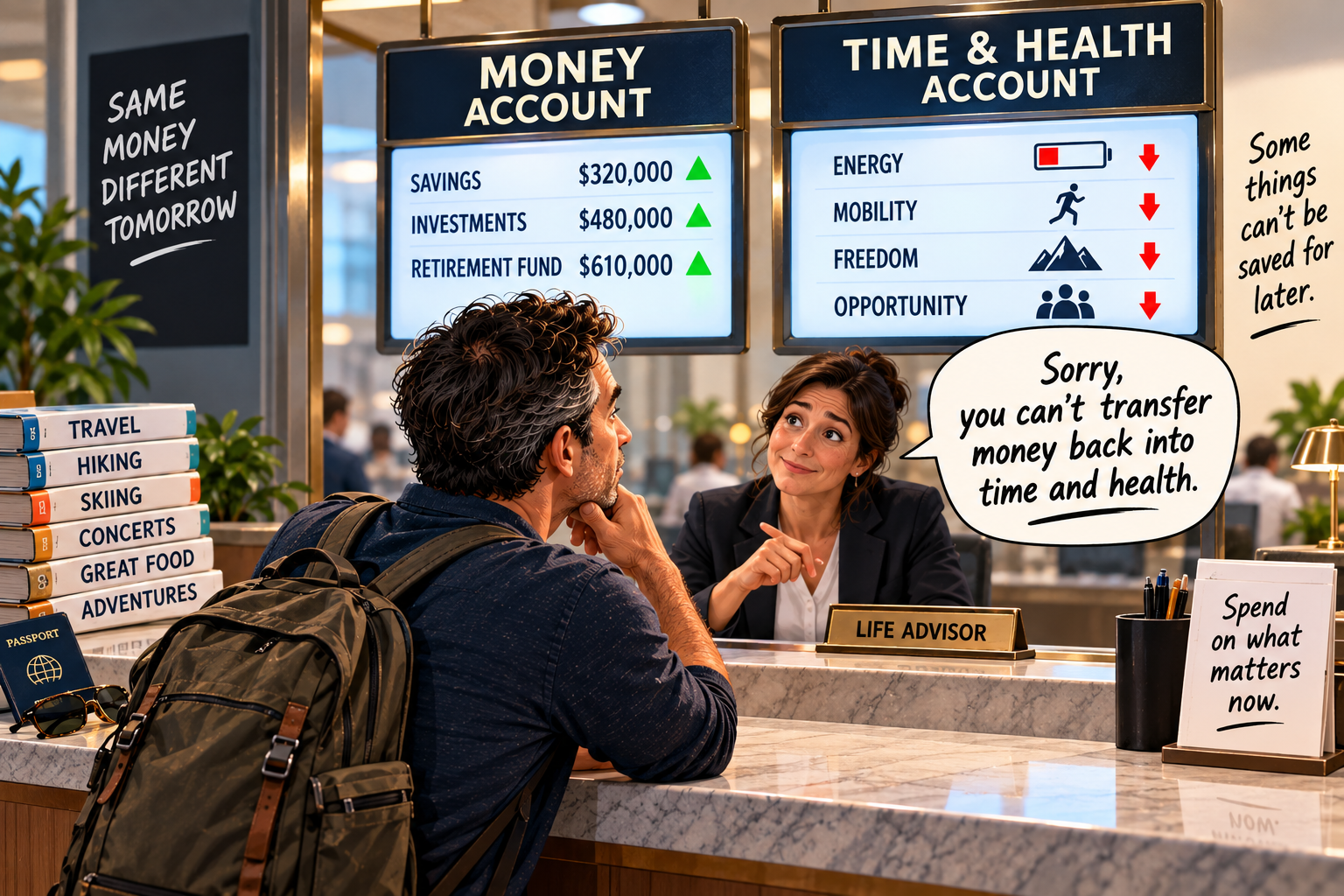
But being over 50 adds another dimension to it. There are trips I want to take and physical experiences I want to have while I know I’m healthy enough to fully enjoy them. Hiking somewhere spectacular, skiing, spending a day exploring a city on foot or taking a trip that requires a little more energy and adventure. I can save the money and tell myself I’ll do those things at 70, but I can’t save today’s health and use it later.
I’d probably feel that way even if I were wildly optimistic about the next decade. I’m not.
That’s where the uncertainty adds another layer. If I already know there’s a limited window for some of the things I want to experience, and at the same time I’m increasingly unsure what my income, the economy or the world around me will look like five or ten years from now, postponing them starts to feel even less appealing.
Again, that doesn’t translate into spending everything now. I’m still saving. I’m still planning for the future. But I’m less interested in maximizing the amount of money Future Me will have if doing that means unnecessarily restricting what Present Me gets to experience.
Maybe everything works out beautifully and ten years from now I have the same financial freedom I have today. Great. But if circumstances eventually force me to become more conservative, I’ll deal with that when they arrive. I don’t particularly want to impose those restrictions on myself years early just because I’m worried they might.
The new couch can wait.
That’s one of the problems with the phrase “consumer spending.” Economists see dollars moving through the economy. We experience those dollars as individual decisions, and $5,000 spent on something meaningful today doesn’t necessarily feel the same as $5,000 left untouched for some uncertain version of tomorrow.
That doesn’t mean Americans have collectively reached the same conclusion. I’d actually like to know whether the data shows a meaningful shift toward experiences or whether this is simply how I personally think about spending.
But it raises a broader question that I don’t remember thinking about nearly as much when I was younger:
What is the cost of waiting?
Saving money has value. So does using it while you have the health and opportunity to enjoy what it can buy. And if you’re increasingly uncertain about what the future is going to look like anyway, perhaps the value of waiting changes too.
Of Course, There’s a Dangerous Version of This
There’s an obvious problem with turning uncertainty into an excuse to spend.
The future eventually shows up. “The next ten years look rocky, so screw it” sounds considerably less clever when the credit card bill arrives next month.
And current consumer behavior gives us reasons to be cautious. People are already making tradeoffs, and some households are leaning more heavily on credit while dealing with higher prices and expenses. The fact that Americans continue spending doesn’t mean everyone can comfortably afford what they’re buying.
That’s an important distinction.
I’m not arguing that uncertainty makes saving pointless. If anything, an unpredictable future makes having savings more valuable.
The question is how far you take it. How much of your life today should you give up to protect yourself against something that might happen tomorrow?