
Dollar stores are growing, Target has cut thousands of prices, big renovations are being postponed and shoppers are making more deliberate choices. The American consumer hasn’t stopped spending. We’ve just become a lot more careful about where the money goes.
I’ve developed a new habit when I shop. I look at the price.
I realize this doesn’t exactly qualify as groundbreaking personal-finance advice, but apparently I’ve joined the growing ranks of price conscious consumers. I mean I really look at the price now. I notice when the cereal is $7. I compare the two packages of paper towels. I stand there wondering whether the slightly better olive oil is actually $6 better. Things I used to toss into a cart without much thought have somehow become tiny purchasing decisions.
Judging by the latest retail numbers, I have plenty of company.
Dollar General and Dollar Tree both reported better than expected sales, helped by consumers looking for cheaper everyday products. Dollar General’s comparable sales rose 3.5%, while Dollar Tree’s rose 3.7%.
The Wall Street Journal’s coverage of Dollar General adds some useful context: the company raised its outlook after sales and profits beat expectations, with comparable sales benefiting from both higher customer traffic and bigger transactions.
Those aren’t extraordinary growth numbers, and I don’t think the takeaway is that America has suddenly abandoned regular stores for Dollar Tree.
We’re still shopping. We’re just paying a lot more attention to what things cost.
The Dollar Stores Aren’t Exactly Having a Gold Rush
Let’s start with the numbers, because it’s easy to get carried away with a headline about booming dollar stores.
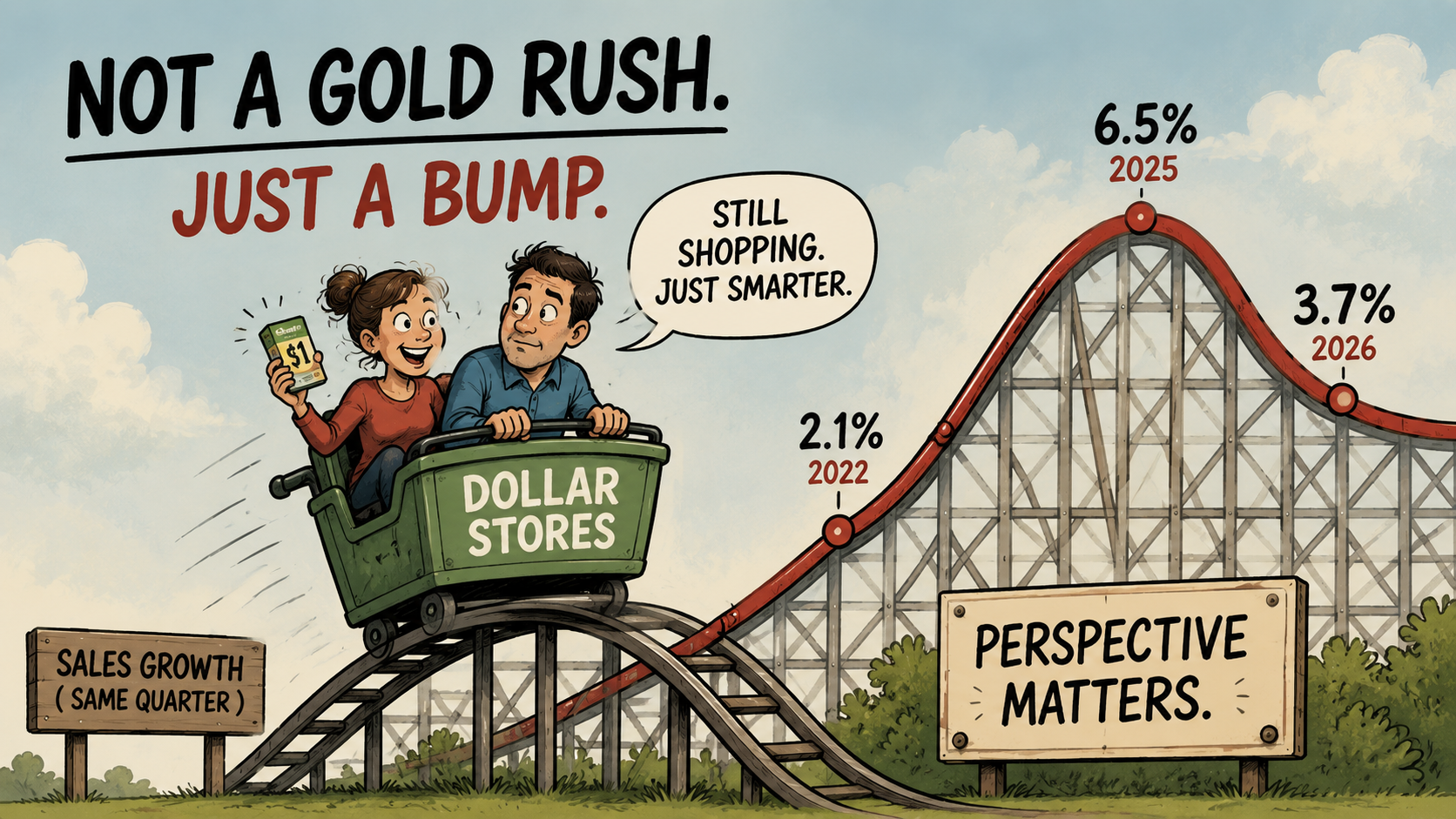
Dollar General’s 3.5% comparable sales increase is solid. Dollar Tree’s 3.7% is solid too. But neither suggests Americans are stampeding through the doors carrying empty wallets. At Dollar Tree, for example, most of that 3.7% increase came from customers spending more per transaction. Average ticket rose 3.3%, while traffic increased just 0.4%.
And here’s some useful perspective: according to Dollar Tree’s own quarterly results, comparable sales grew 6.5% in the same quarter last year. So this year’s 3.7% hardly looks like the beginning of some extraordinary dollar store boom.
So I’m not ready to declare this the Great American Migration to the Dollar Store. What matters is why these retailers say customers are coming.
Reuters reports that economic uncertainty and high food and gasoline costs are pushing consumers toward cheaper essentials. Lower income households in particular are cutting discretionary purchases, while wealthier consumers remain considerably more comfortable.
There’s an interesting wrinkle here too. The Wall Street Journal’s Dollar Tree coverage describes demand as strong across income levels, particularly among budget conscious shoppers. That’s important because looking for value isn’t necessarily something people start doing only when they’re struggling financially.
That’s where today’s dollar store results become more interesting. They’re not an isolated phenomenon. They’re one piece of a much larger shopping pattern.
Target Has Noticed Too
You don’t have to shop at Dollar General to be looking for a deal. Target just reported a pretty healthy quarter. Comparable sales increased 3.8%, actually slightly more than Dollar General or Dollar Tree, and customer traffic rose 3.6%.
But one detail in Target’s results jumped out at me. The company says it has lowered prices on more than 10,000 frequently purchased items over the past year. Ten thousand!
Target isn’t cutting 10,000 prices out of some newfound devotion to the American consumer. It’s doing it because we’ve started paying a lot more attention to what things cost. The retailer specifically lists value alongside style, design and convenience as central to its current strategy. It also says 95% of its school-supply assortment is now priced at or below last year’s levels.
And it’s working. People aren’t abandoning Target for dollar stores. Target’s sales are growing too.That’s important because this isn’t necessarily about Americans becoming poorer shoppers. We’re becoming more price conscious consumers, regardless of whether we can technically afford to spend more.
Walmart Is Seeing It From the Other Direction
Then there’s Walmart, which gives us another piece of the puzzle.
Walmart recently reported its slowest comparable sales growth in six years, even as the company has been aggressively cutting prices. The company pointed to pressure from gasoline prices and a consumer who is becoming more selective, according to Reuters.
A broader Reuters analysis of recent retail earnings found a particularly interesting pattern: shoppers aren’t simply shutting their wallets. They’re prioritizing.
Middle income households are focusing more heavily on essentials and postponing major purchases. At the same time, they’re still finding room for relatively inexpensive treats, like a restaurant meal or a coffee, while affluent shoppers continue spending much more freely.
That feels much closer to the consumer economy I recognize. People don’t wake up one morning and announce, “Due to current macroeconomic conditions, I shall cease consuming.” They adjust.
Maybe you buy the cheaper detergent. Maybe you wait for the sale. Maybe you keep Friday night’s dinner out but postpone replacing the couch. And when enough people make enough of those little decisions, eventually they start showing up in corporate earnings reports.
The Kitchen Remodel Can Wait
You can see it especially clearly when the purchase gets bigger.
Home Depot reported that U.S. comparable sales rose just 1.3% last quarter. Customers are still spending on repairs and maintenance, but high borrowing costs and a sluggish housing market continue weighing on large renovation projects.
Lowe’s tells a similar story, and here I’d actually rather hear it directly from the company. Its second-quarter results show comparable sales rose just 0.2%, while CEO Marvin Ellison specifically pointed to continued pressure on discretionary DIY spending. Lowe’s also reduced its full-year comparable-sales outlook from as much as 2% growth to essentially flat.
The leaky faucet gets fixed. The $60,000 kitchen renovation gets another year to develop character. That distinction matters because it helps explain why consumer spending can remain relatively healthy while people simultaneously feel cautious.
We’re not necessarily eliminating purchases. We’re ranking them.

I Don’t Think We’re Cheap. I Think We’ve Adjusted to a New Reality.
Looking for value isn’t the same thing as being unable to afford something. Sometimes it’s simply what happens when years of higher prices force you to reconsider what things are actually worth to you.
Maybe you buy the store brand because you need to save the $2. Maybe you can comfortably afford the name brand and have simply decided it’s no longer worth $2 more. Maybe you postpone the kitchen renovation because you can’t afford it right now, or maybe you look at the cost of borrowing $60,000 at today’s interest rates and decide that your perfectly functional 2012 kitchen suddenly has a lot more charm.
We’ve lived through several years in which the price of almost everything moved noticeably higher. At some point, you adapt. You compare more. You wait for the sale. You switch brands. You decide some things aren’t worth what they cost anymore, even if technically you could afford them.
And maybe that’s the part retailers are beginning to understand. The American consumer is still there. We’re just making them work a little harder for our money.
I don’t think that’s being cheap. I think that’s adjusting to reality.
Have you noticed your own shopping habits changing over the last few years — even if your financial situation hasn’t? What do you compare, wait for or simply refuse to pay for now that you wouldn’t have thought twice about before? I’d love to hear it in the comments.