
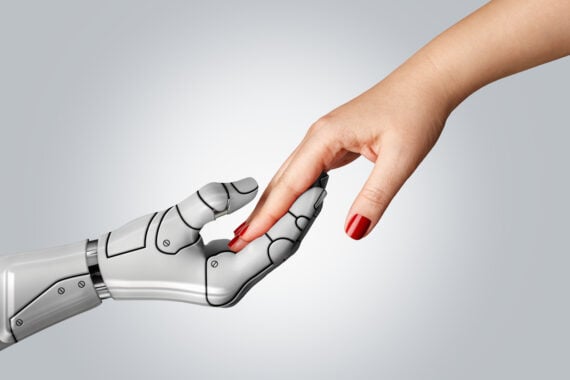
Just when women were getting comfortable juggling wage gaps, burnout, caregiving, workplace bias, and the general state of the world, another things is being added to the mix: artificial intelligence.
A new report finds that AI is most likely to disrupt jobs dominated by women — and not in a “this will free you up for more creative work” kind of way. More like a “your role is extremely automatable, and you may not have a soft landing” situation. Fun times.
The findings come from a joint analysis by the Brookings Institution and the Centre for the Governance of AI, which looked at which occupations face the highest exposure to AI and how well workers in those roles are positioned to adapt if their jobs disappear.
The Jobs AI Affects First
According to the report, more than 6 million workers are at high risk of AI-driven job loss and are the least equipped to recover. About 86% of them are women.
These workers tend to be older, have fewer savings, and work in clerical or administrative roles — jobs that have quietly been absorbing technological “efficiency” upgrades for decades. Think secretaries, payroll clerks, administrative assistants, and court clerks. The kinds of roles that keep offices functioning, but are rarely treated as irreplaceable.
“These are occupations that have been under attack for a long time,” one of the report’s authors noted, which is a polite way of saying technology has been slowly circling them for years, and AI just sped things up. Researchers stressed that this isn’t about women being less capable (duh). It’s about where women are concentrated in the economy. Jobs with repetitive, standardized tasks are easier for AI to replicate, and historically, those jobs have been filled by women.
Adaptability Is the Real Divide
The report also makes a crucial distinction that tends to get lost in the “AI is taking our jobs” discourse: Exposure isn’t the same as adaptability. Right around 70% of workers in AI-exposed roles are expected to be able to pivot into comparable jobs if they lose theirs to the bots. These tend to be positions that combine technical, creative, and managerial skills, like marketing managers, financial analysts, designers, producers, and tech leaders. Those roles are more likely to require judgment, strategy, and cross-functional thinking. In other words, the kind of work AI can assist with but not fully replace (yet).
Unfortunately, many administrative and back-office roles don’t come with that same flexibility. When the core function is organization, processing, or documentation, there’s less room to pivot when software decides it can do the job faster and cheaper.
Is AI Actually Killing Jobs Yet?
Here’s where things get slightly less apocalyptic.
Despite all the headlines, there’s still limited evidence that companies are replacing large numbers of workers with AI right now (though our guards remain up). Economists say adoption is uneven, implementation is messy, and most firms are still figuring out what AI can realistically handle without breaking everything. Mass displacement isn’t happening overnight. But the writing is on the wall, folks.
As such, many women are in an uncomfortable spot: knowing their jobs are highly exposed, knowing retraining takes time and money, and knowing the safety net for mid-career transitions in the U.S. is … optimistic at best.
What Workers Can Actually Do

The report’s advice boils down to this: Engage with the technology instead of pretending it won’t affect you. That doesn’t mean “learn to code” or “become an AI expert overnight.” It means experimenting, understanding how these tools intersect with your work, and finding ways to expand your skill set beyond the narrow tasks most easily automated. Understanding that is like a stepping stone toward uncovering your irreplaceability (and once you find that, you’d better own it — out loud).
That’s easier said than done, especially for workers already stretched thin. But ignoring AI entirely is likely the riskiest option of all.
The Bigger Issue
Women didn’t accidentally end up in roles that are now considered expendable, just like wage gaps were never happenstance. Those jobs were undervalued long before algorithms entered the chat. AI is simply accelerating a reckoning that’s been building for years. And while AI may eventually boost productivity and reshape work for the better (the jury is still out), the transition won’t be neutral. Without intentional policies, retraining pathways, and protections, the burden will fall — once again — on the same group expected to quietly absorb it. What a world for women.
Trending on Cheapism


More From Cheapism

- AI Roles Are America’s Fastest-Growing Jobs, and Everyone Is Just Trying to Keep Up — The report tracks the fastest-growing jobs in the U.S. over the past three years, and the picture is as clear as it is depressing.
- Report Says Employers Added 130K Jobs in January. Job Seekers Aren’t Seeing Them — Economists had expected closer to 75,000 new jobs, so the report reads like a win. But there’s more to the story.
- No College Degree? No Problem. These 10 Jobs Will Pay You Six Figures Anyway — There are growing opportunities in the American workforce that skip the traditional college degree and pay serious money.