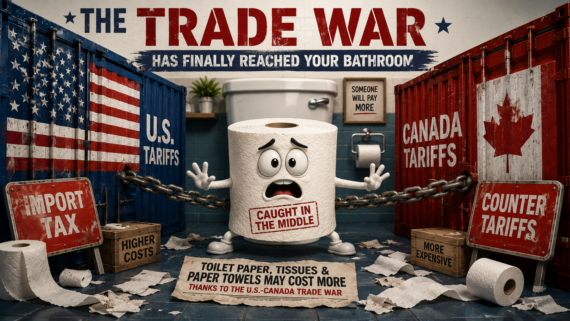
The U.S. and Canada are fighting over tariffs, paper products are caught in the middle, and your toilet paper may end up costing more. This feels like an excellent use of everyone’s time.
I don’t ask much from my toilet paper.
Toilet paper tariffs were certainly not something I expected to have an opinion about. I don’t need my toilet paper to be artisanal. I don’t care whether the trees were locally sourced, emotionally fulfilled or personally thanked for their service. I have never wondered about its journey to my bathroom. There is a job to be done, we all understand what that job is, and I’d prefer to complete the transaction without needing to study international trade.
That may have been an unreasonable expectation.
The latest chapter in the increasingly nasty U.S. Canada trade fight has dragged paper products into the mess, and there are warnings that American shoppers could ultimately see higher prices for toilet paper, tissues and paper towels. The Guardian reports that the U.S. paper industry relies heavily on Canadian raw materials, while the two countries continue piling tariffs and retaliatory tariffs onto goods moving across what used to be a considerably less dramatic border.
We’ve reached the point where buying something to wipe your ass may involve a working knowledge of North American trade relations.
Now that’s progress.
How Did Canada Get Into My Bathroom?
There’s actually a reason Canada matters here beyond its inconvenient location immediately above us on the map.
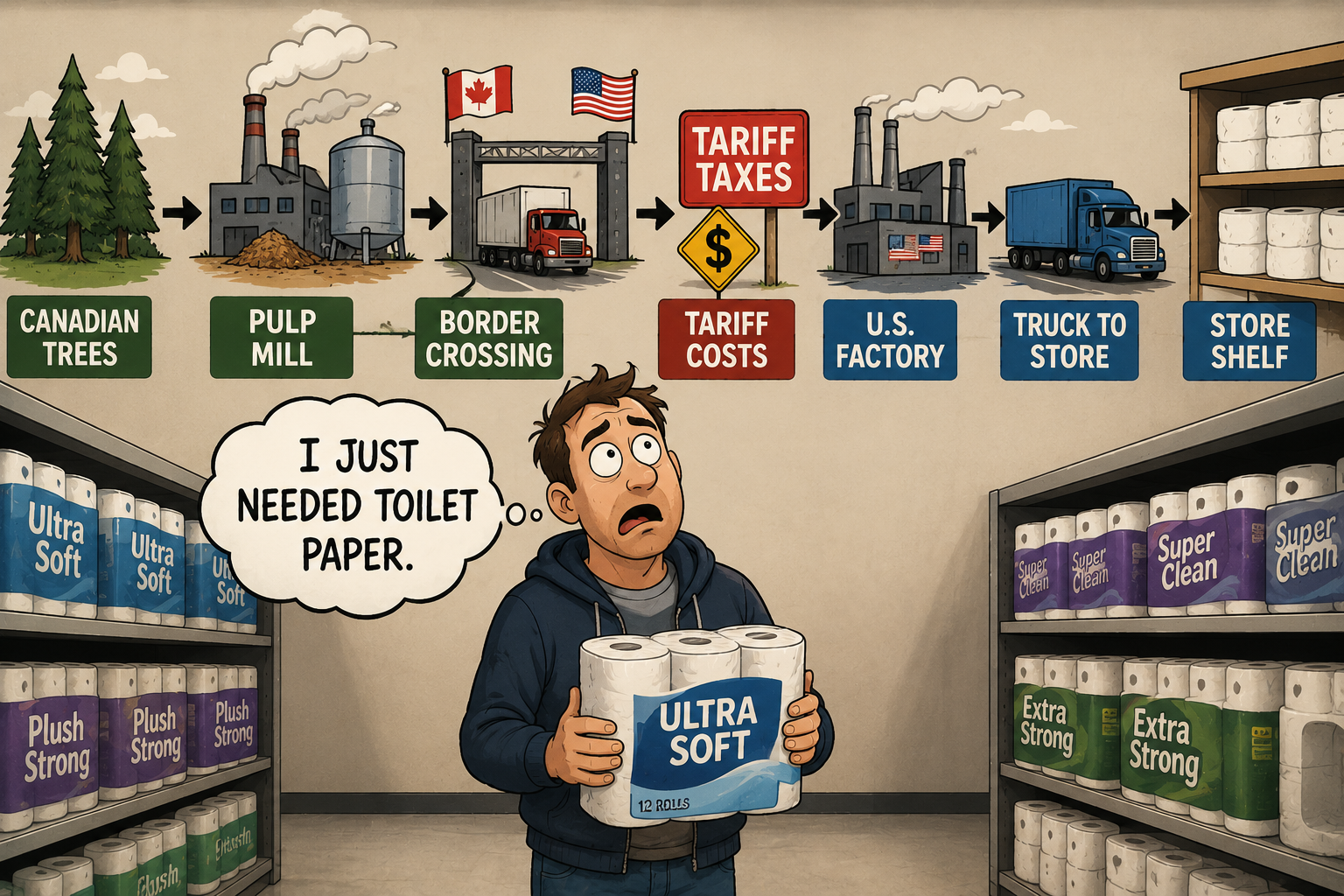
The U.S. and Canadian paper industries are closely connected. American manufacturers produce plenty of toilet paper domestically, but Canada is an important supplier of the pulp and other materials used to make paper products. The U.S. also imported about $328 million worth of toilet paper from Canada in 2024, according to trade figures cited by The Guardian.
Normally, none of this would be information I particularly need.
I don’t know where the steel in my refrigerator came from either. I couldn’t identify the international journey of my socks. That’s one of the nice things about modern civilization: thousands of people arrange incredibly complicated supply chains so that I can walk into a store, buy a 12-pack of toilet paper and remain blissfully ignorant of the underlying logistics.
Then politicians start throwing tariffs at each other, and suddenly I’m learning about pulp.
And That’s When Tariffs Step In
The dispute itself has escalated quickly.
After trade negotiations broke down, the United States imposed 50% tariffs on roughly $20 billion worth of Canadian goods on August 22. Canada responded by announcing dollar for dollar countermeasures covering $27.6 billion in U.S. imports, scheduled to take effect September 8, according to the Canadian government.
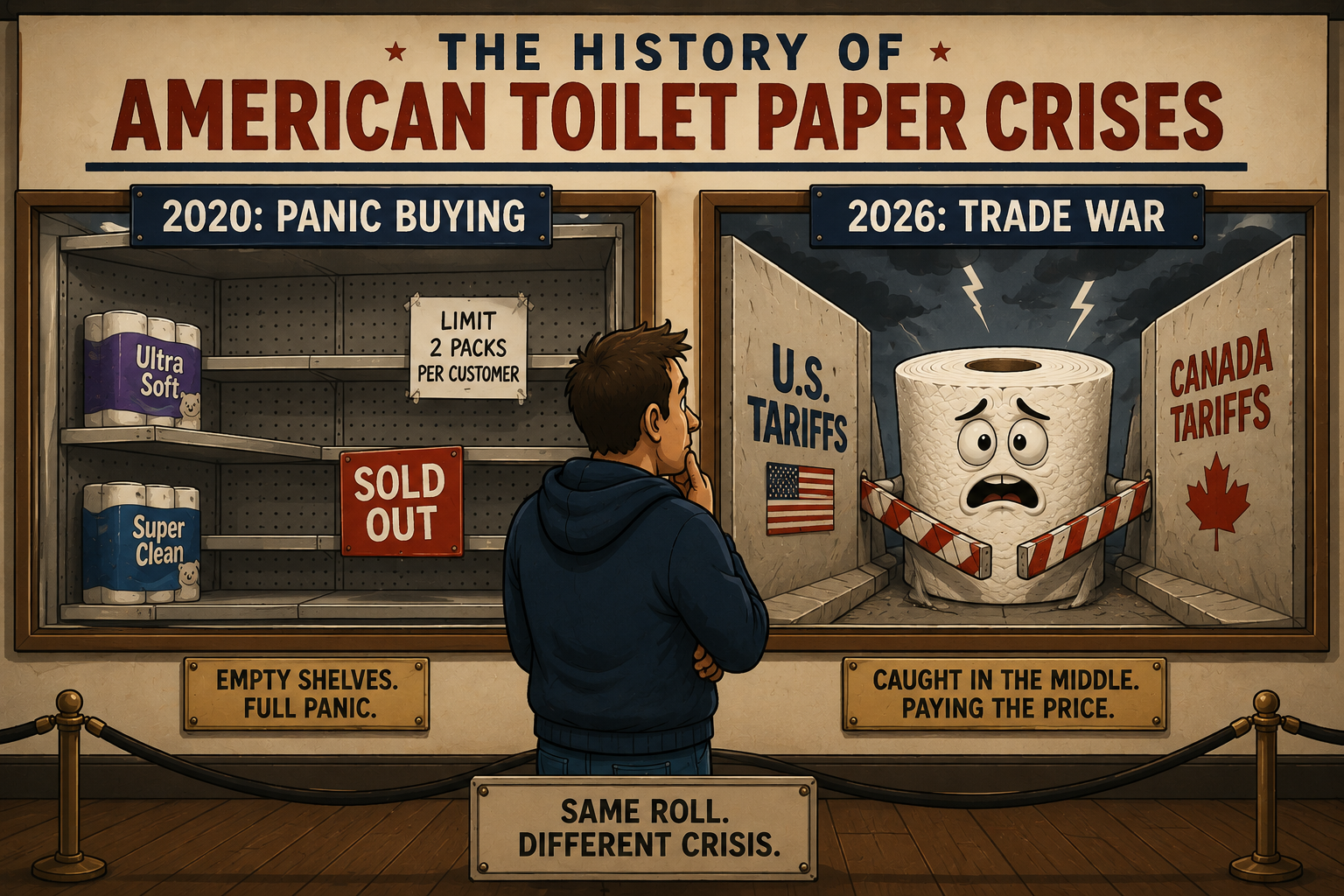
And buried inside Canada’s extraordinarily long list of products are the sorts of things no sane person associates with international brinkmanship: envelopes, paperboard, facial tissues, paper towels and, yes, toilet paper. So yes, toilet paper tariffs are now officially a thing.
Canada’s official tariff list puts a 25% tariff on U.S. origin toilet paper and facial tissues, while some other pulp and paper categories face tariffs as high as 50%.
Imagine being toilet paper for a minute… for your entire existence, your ambitions have been modest. Sit quietly on a shelf. Do your duty. Avoid becoming the subject of conversation at dinner.
Then one morning you wake up and you’re part of a trade war. I suppose everybody gets their moment.
For American consumers, the bigger concern is what this escalating trade fight does to a paper industry that doesn’t neatly stop at the border. American toilet paper and tissue manufacturers rely heavily on Canadian pulp and other raw materials, while finished products move back and forth between the two countries. Start making that system more expensive and complicated, and eventually some of those costs have a habit of finding their way to us — which is why The Guardian warns the trade fight could ultimately lead to higher prices for U.S. consumers.
Companies rarely respond to higher input costs by gathering everyone into a conference room and saying, “You know what? Let’s just make less money.”
Eventually somebody sends the bill downstream, and I have a suspicion about who lives downstream.
Haven’t We Been Through Enough With Toilet Paper?
There is also something uniquely irritating about toilet paper being involved in another national economic story.
We already did this.
In 2020, Americans briefly behaved as though toilet paper was a precious metal. People filled shopping carts with it. Shelves were stripped bare. Stores imposed purchasing limits. Somewhere, presumably, a person sat proudly atop 400 rolls of Charmin feeling vindicated about his investment strategy.
I thought we’d closed that chapter.
Six years later, toilet paper has found a new way back into the economic news, except this time nobody is panic buying it. We’re simply being warned that the complicated trade relationship between two of the world’s closest neighbors could make yet another boring household necessity more expensive.
That’s somehow less exciting.
Can We Please Leave the Toilet Paper Alone?
There are enormous questions wrapped up in the U.S. Canada trade dispute. Jobs, manufacturing, national industries and tens of billions of dollars in trade matter considerably more than whether my next package of toilet paper costs another buck.
I understand that.
But consumers have already spent years becoming unwilling experts in inflation, shrinkflation, supply-chain problems, surcharges, interest rates and the fascinating science of discovering how much smaller a package can become while technically remaining the same product. I really don’t want to add international pulp economics to the curriculum.
And yet, this is how all those giant economic decisions eventually reach us. They turn into tiny changes on a shelf, and enough tiny changes eventually become a grocery bill that makes you wonder what the hell happened.
Toilet paper isn’t going to bankrupt the American family. That’s almost what makes it such a perfect example.
It’s boring. It’s necessary. Nobody is splurging on it because they got a bonus. Nobody is going to dramatically rethink their toilet-paper lifestyle because prices increased. We’ll grumble, we’ll pay, and we’ll move on to the next thing that somehow got more expensive.
I just miss the days when I could buy toilet paper without wondering what Canada was up to.
What completely ordinary product have you noticed getting ridiculously expensive lately? Tell me in the comments. I’m curious which aisle we should investigate next.