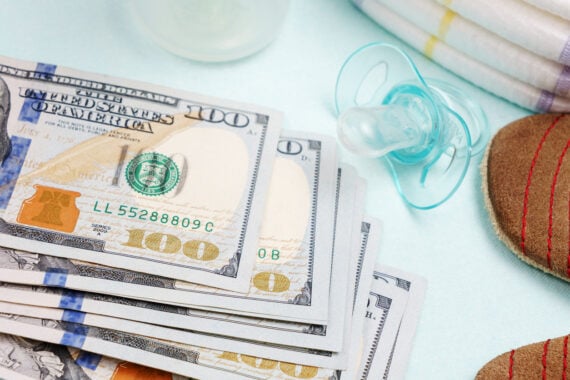
Tax season has brought us a fresh financial concept: Trump Accounts, a new federal savings plan launching on July 5 that automatically puts $1,000 into an investment account for every baby born between 2025 and 2028.
At the official Trump Accounts Summit in January — and again during President Trump’s State of the Union address on February 24 —the program was positioned as a win for American families and their kids’ financial futures, a sort of starter seed for retirement or adult expenses (you know, the ones the parents of those babies have). Big banks like JPMorgan Chase and Bank of America even pledged to match $1,000 contributions for eligible employees, and credit card companies said you could funnel rewards into these accounts, too.
A Grand Gift in the Context of a Very Expensive Reality
Having a baby in the United States isn’t cheap. From prenatal care through childbirth and postpartum care, medical costs alone can average more than $20,000. That’s before you even consider diapers, formula, childcare, housing adjustments, food, and the lifelong costs of raising a child.
And that $20,000+ figure just scratches the surface. A separate analysis found that raising a child from birth through age 18 can cost around $414,000 on average, with childcare alone eating up a massive share of that total. So yes, the government will put a $1,000 check in an account when a baby is born. But meanwhile, families are often spending tens of thousands of dollars just to bring that baby into the world and position themselves to survive day to day. It makes us want to stick a pacifier in our mouths.
What Trump Accounts Really Are — And What They’re Not
Here’s the straightforward breakdown:
- The government funds a one-time, $1,000 deposit for qualifying newborns’ Trump Accounts.
- Parents and others can contribute up to $5,000 annually until the child turns 18, but that’s optional.
- The accounts invest in low-cost stock index funds, and money generally can’t be touched until age 18.
- After 18, funds work similarly to an IRA and can be used for retirement, education, or first-time home purchase expenses.
Financial advisors will tell you that starting to invest early is a good idea. And sure, a free $1,000 is better than no free $1,000. (Especially if someone actually remembers to claim it on their taxes.) But for families, that $1,000 won’t materially help them pay for everyday needs like food, rent, childcare, or the unexpected medical bills that come with a new child.
The Long Game Isn’t What Most Families Are Playing
Financial planners often recommend starting retirement savings early, and having a nest egg by age 18 certainly sounds helpful. But most families aren’t worried about compound interest 30 years from now when they’re trying to figure out how to pay rent this month, keep food on the table, or afford daycare that can run upwards of $1,000 per child per month.
Trump Accounts might theoretically encourage long-term saving — and yes, a little bit of free money is something no parent should pass up. But for many Americans, the day-to-day costs of raising a child (and existing adults’ needs for groceries, bills, and basic expenses) loom much larger than a one-time $1,000 deposit.
More From Cheapism

- Want to Be a Stay-at-Home Parent? New Study Shows Your Partner Needs to Make Six Figures — If one parent is going to stay home, the other needs to bring in around $100,000 a year to make it happen.
- What’s Your Most Expensive Bill? Child Care Tops the Cost of Rent for Many Americans Now — Child care has officially leapfrogged rent as the biggest line item in a family’s monthly budget.
- Reverse Budgeting: How the ‘Pay-Yourself-First’ Approach Can Boost Your Savings — Reverse budgeting (or “paying yourself first”) is exactly what it sounds like: You treat your savings like a non-negotiable bill.