Companies already know what we buy, where we live and what we search for. Apparently, knowing how much they can get us to pay is the next frontier.
Remember when companies started collecting enormous amounts of information about us so they could provide a more “personalized experience”? Well, good news, we may have finally reached peak personalization: They’re personalizing the price!
The Federal Trade Commission released a draft policy this week taking aim at what’s known as “surveillance pricing”: using information about individual consumers to help determine the prices or offers they see. According to Reuters’ report on the proposal, the FTC says companies could be crossing the line if they’re doing this without clearly telling us.
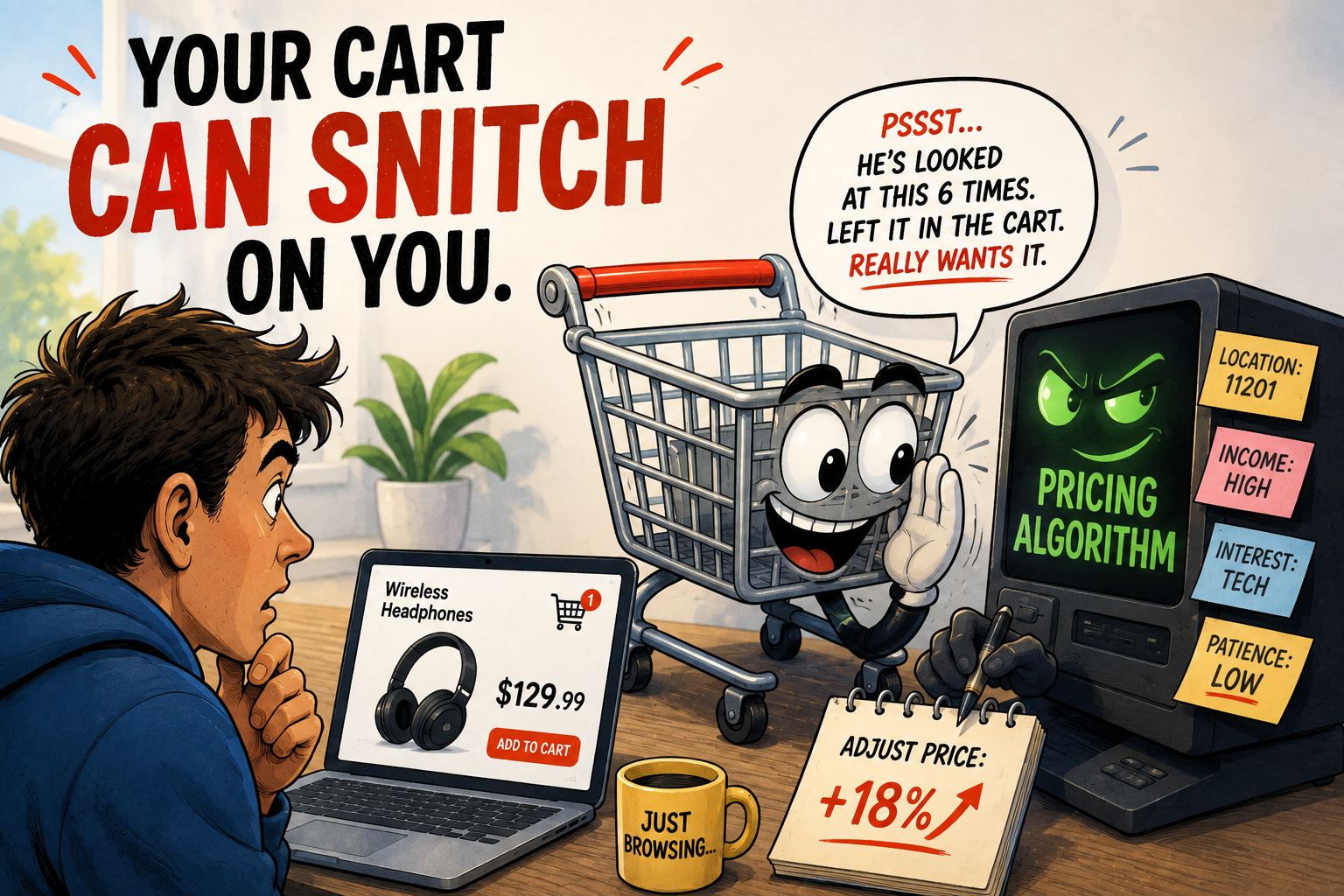
And what might go into deciding your special little price? According to the FTC’s own research into surveillance pricing, potentially your location, demographics, browsing history, shopping history and even how you behave on a website. How thoughtful.
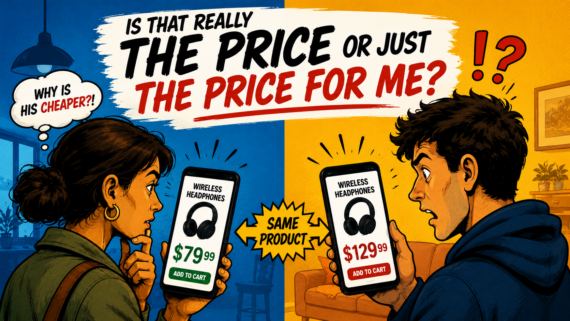
So when a product pops up for $79, that number doesn’t necessarily have to mean “This product costs $79.” It could mean “We’ve looked at you and $79 feels about right…”
Apparently, Even Your Shopping Cart Can Snitch on You
This isn’t technology somebody is dreaming about for 2035. The FTC has been investigating companies that sell pricing technology to retailers since 2024. The companies it studied work with at least 250 clients, including grocery and clothing businesses, and the technology can use enormous amounts of consumer information to tailor prices, promotions and even which products we see.
Basically, everything you do while shopping can become part of the conversation. Look at something repeatedly? Interesting. Leave it sitting in your cart? Hmm… Live in a certain ZIP code? Fascinating. At this rate, hesitating over the BUY NOW button is going to qualify as a financial disclosure.
Grocery shopping has already shown us how strange digital pricing can get. Pricing experiments involving Instacart resulted in different shoppers seeing different prices for identical groceries from the same store, with differences reaching as much as 23%, according to Reuters.
Let me just disclose, before everyone starts yelling at Instacart: the company said customers were randomly assigned to test groups. It wasn’t using their personal information to decide who deserved the expensive bananas, and Instacart later ended the experiments. So this wasn’t surveillance pricing, and we have no new information that Instacart even engages in such practice anymore.
But it does introduce a lovely new concept into shopping: my price doesn’t necessarily have to be your price. For most of my life, I assumed the price tag belonged to the product. Apparently that’s becoming old-fashioned. A price tag belongs to a person.
And Then There Are Airlines
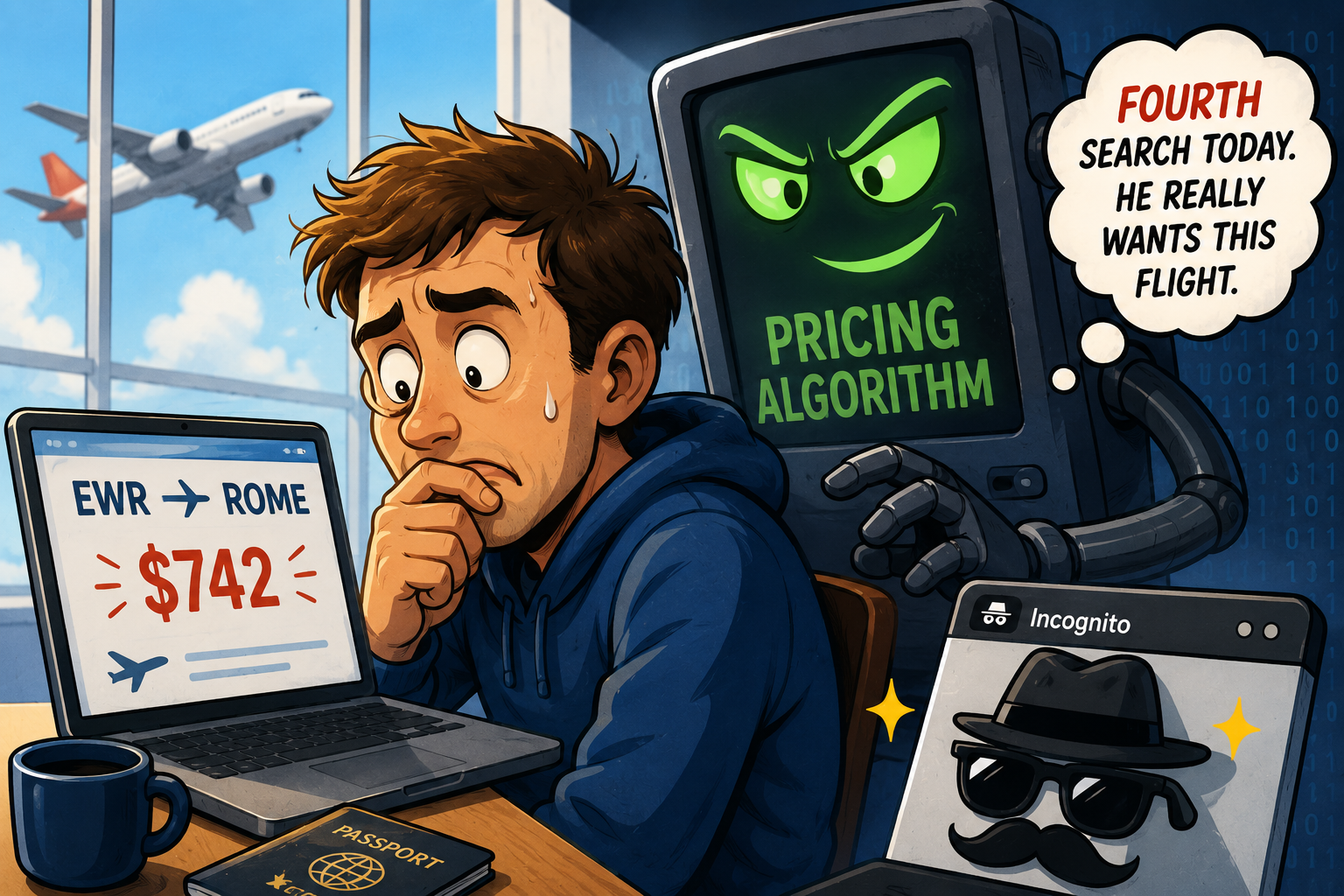
This is where I have to confess something. When I’m shopping for an expensive flight and I’ve searched the same route approximately 47 times, I switch to incognito mode because there’s a little voice in my head saying, They know.
They saw me search Newark to Rome Monday morning. Then Monday night. Tuesday morning I came crawling back. By Wednesday, even I would charge me more.
Now, before I accidentally start an internet conspiracy theory, I have no evidence that airlines are actually raising my individual fare because I’ve been obsessively searching for it. I also have no clue if incognito mode even helps, and magically gets you cheaper airfare. But I keep doing it. It makes me feel like I’m fighting back.
And apparently I’m not completely insane for wondering where this could eventually go. Delta attracted attention from lawmakers last year over its expanding use of AI in pricing. Senators worried that AI could eventually be used to calculate an individual customer’s maximum “pain point.”
Delta’s response was unequivocal: it says it doesn’t use personal information to set individualized fares and doesn’t plan to. Its AI tools, the airline says, are being used to improve traditional pricing based on things like demand and competition. You can read more about the dispute in Reuters’ reporting here.
Fair enough Delta execs, I have absolutely no grounds to accuse you, or any other airline, of watching my increasingly desperate online flight searches, but I’m still keeping incognito mode.
When the Price Tag Starts Watching You Back
The issue isn’t really that prices change. They’ve always changed. A flight gets expensive because everyone wants it. A hotel doubles its rate on the 4th of July weekend. A ride suddenly costs twice as much because it’s raining and everyone wants to go home. Annoying? Absolutely. Mysterious? Not really. The demand changed, so the price changed.
Personalized pricing introduces something entirely different, though: the demand didn’t change; the company just learned too much about you.
The FTC gives a particularly nasty hypothetical example. Imagine you’re booking a hotel because you’re traveling for a funeral. Your personal data somehow tells the hotel why you’re traveling, and the pricing system concludes that you’re probably not going to postpone Grandma’s funeral because the room rate went up $40.
To be clear, the FTC isn’t accusing a particular hotel company of doing this. It’s illustrating what this technology could theoretically allow. But that’s precisely the point. There is a very big difference between “Rooms are $240 tonight” and “Your room is $240 tonight.” One is pricing. The other suggests that personalized data is taking several steps too far.
Of Course, I Love Surveillance When It Saves Me Money
Here’s where my moral outrage gets slightly less consistent. Let’s say I’ve looked at a pair of sneakers six times and refused to buy them. Then an email arrives offering me 20% off.
In that case, please continue monitoring me. Analyze my behavior. Study my mouse movements. Bring in consultants. Apparently I have principles until there’s a coupon.
And that’s what makes this more complicated than simply saying personalized pricing is bad. The same information can be used to offer loyalty discounts, targeted coupons and deals.
My rule is considerably simpler: Use what you know about me to figure out how little you’ll accept? I like you. Use what you know about me to figure out how much I’ll tolerate? Now you’re pissing me off.
So I’m curious: Would personalized pricing bother you if companies clearly disclosed it? And have you ever suspected that a website was changing a price because of what it knew about you?
And, more importantly, does anyone else search flights in incognito mode? Please tell me I’m not the only one.