

If the Great Resignation was about switching companies, the current trend is about switching continents. For generations, the U.S. was the ultimate destination for global talent, but the tide is officially turning.
A recent study from workforce intelligence company Revelio reveals that the share of employees leaving their U.S. jobs to work abroad has more than doubled in just four years, climbing from 2.7% in 2021 to 6% by the end of 2025. Whether they are joining international firms or taking their American remote roles to cheaper time zones, U.S. workers are proving that the corner office is no longer the ultimate goal … a passport is.
Technology Professionals Driving the Move Overseas
Technology professionals are leading the migration wave. In December 2025 alone, nearly 16% of job switchers in IT consulting started new roles outside the U.S.
For the first time in recent history, the brain drain has reversed: more U.S. tech workers moved to Europe last year than European workers moved to America. As Europe invests heavily in AI and cloud infrastructure, it isn’t just offering competitive roles; it’s offering a lifestyle that the Silicon Valley hustle can’t match.
Why Are Workers Leaving the U.S.?
Groceries are expensive. Gas is expensive. Walking outside your home and existing in America is expensive. All of that has a ripple effect, and workers are leaving the states for three primary reasons:
- The Remote Work Mandate: While many U.S. companies are enforcing strict return-to-office (RTO) policies post-pandemic, international employers are using hybrid flexibility as a recruiting tool.
- Purchasing Power: In an economy where over half of Americans feel their finances are worsening, living where money goes further is a massive draw. Especially if they’re still getting paid in U.S. currency all while living somewhere where the U.S. dollar has more buying power.
- The Quality of Life Package: Nominal pay may be lower abroad, but workers are trading higher salaries for better public transportation, universal healthcare, and subsidized childcare … the views and food probably don’t hurt either.
The Reverse Migration Reality
While a small percentage of this trend includes U.S.-born citizens, a significant portion is driven by foreign-born workers. As of late 2025, 30% of foreign-born job switchers chose to leave the U.S. entirely.
“Talent is not infinite,” says Revelio economist Ege Aksu. In a global labor market, American companies are realizing that a high salary isn’t enough to keep top-tier talent if the “overall package” of living in the U.S. involves high-stakes financial gambles and burnout.
The American workforce is becoming less bound by geography and more motivated by mobility. With roughly 2,500 workers leaving the country every month for jobs in France, the UK, and beyond, the message to U.S. employers is clear: if you don’t offer a better quality of life, someone across the ocean will.
Working from home for an American company while living in a transit-rich European city? For many in 2026, that is the new American Dream.
More from Cheapism
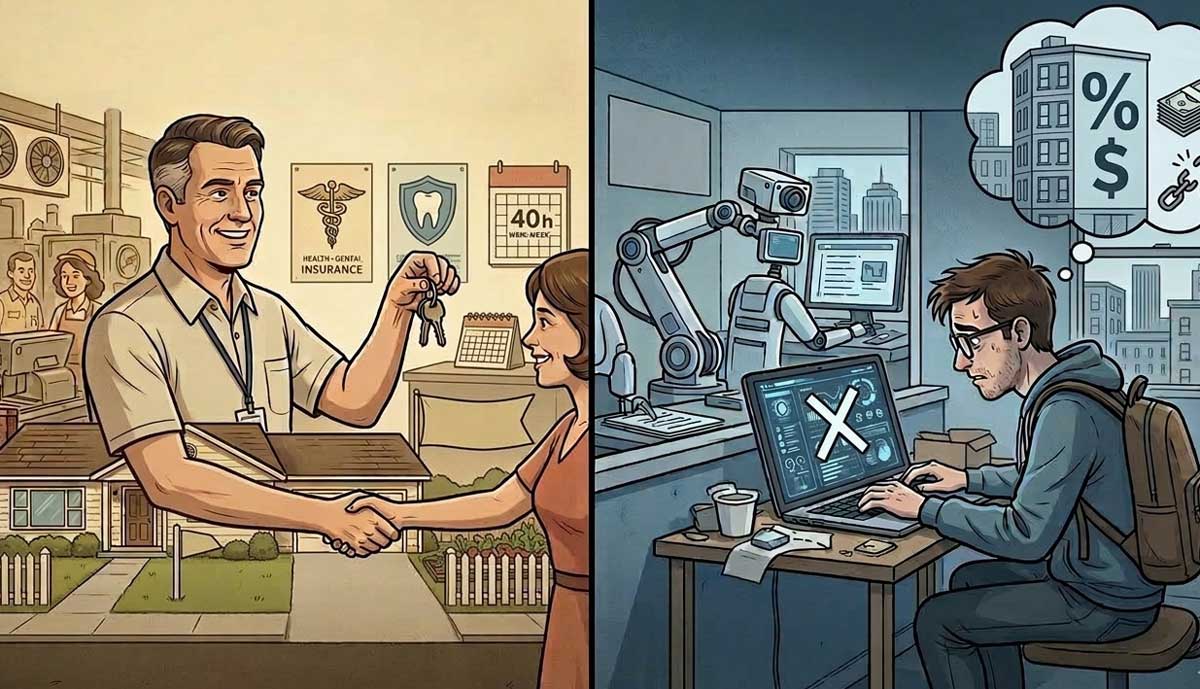
- ‘Outmoded and Distant’: Is the American Dream Over? — The workforce isn’t the only reason the American Dream is turning into a nightmare. From the job market to the housing crisis, Americans are discouraged in more ways than one.
- These Freelance Jobs Pay $100 an Hour — If you’re thinking about moving abroad and taking on a remote gig, these freelance opportunities are some of the highest-paying you’ll find.
- These Jobs Pay $100 an Hour Without a College Degree — No college degree? No problem. These high-paying jobs will earn you $100 an hour without a formal education.