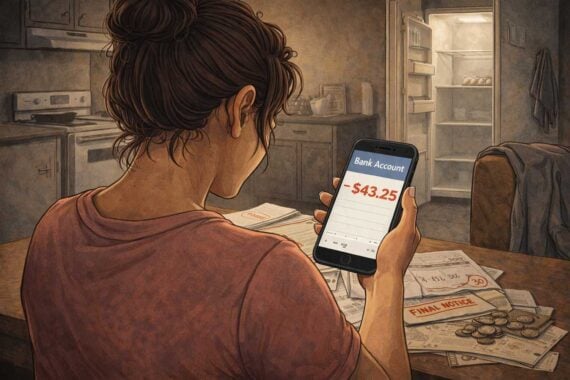
Living paycheck to paycheck sounds almost routine at this point — like a budgeting style, or a phase, or something you grow out of once you make a little more money. But that’s not what it actually is.
For millions of Americans, it looks like running out of money before the month runs out. It looks like covering groceries with what was supposed to be savings. It looks like hoping nothing goes wrong … because there’s quite literally no room for it if it does. And right now, it’s hitting people squarely in their prime earning years.
In a recent survey, nearly 90% of respondents living paycheck to paycheck were between 29 and 44 — not just getting started, not winding down. Instead, they’re right in the middle of careers, bills, and everything that’s supposed to feel stable.
Debt Becomes the Safety Net
For many people, the math just isn’t in their favor. According to the survey, nearly 40% of those living paycheck to paycheck say they end the month with less than $50. Another 34.7% have nothing left at all. When there’s no extra money, something has to give — and for most people, that “something” is debt.
About 60.6% of people living paycheck to paycheck say they’ve fallen into debt as a direct result, with an average of $739 added just to keep up. That’s not for vacations or big purchases, it’s just to stay afloat.
One Redditor explained how, when you’re broke, you hyperfixate on every purchase, commenting, “It’s so hard to enjoy food when you’re constantly thinking about how much each bite costs. I literally just eat oatmeal and soup lately, cause I can just shovel it in without really thinking about it.” Another user agreed, lamenting that “whoever is involved in all this world chaos” is “sucking our lives dry.”
Savings Don’t Really Exist — or They Don’t Last
In theory, savings are supposed to be the fallback. In reality, they’re often the first thing to go. Nearly everyone (95.4%) who’s lived paycheck to paycheck says they’ve had to dip into savings just to cover everyday expenses. As one Redditor put it, “I had a $100 emergency fund, but then I had an emergency and I have no spare money to rebuild it. They say you’re supposed to have six months’ worth of expenses. I can’t even save $100!”
Close to 40% of people living paycheck to paycheck say they couldn’t cover a $500 expense without borrowing or using credit. That’s not a major crisis. That’s a car repair. A medical bill. A last-minute flight. A broken appliance.
It’s also the exact kind of thing that never shows up at a convenient time.
Bills Don’t Get Paid — at Least Not on Time
When money runs short, something has to be delayed. About 61% of people living paycheck to paycheck say they’ve missed or made late payments in the past year. To keep everything moving, more than half of people (51.6%) say they’ve taken on extra work — freelance gigs, second jobs, anything that brings in additional income.
Sometimes, even two jobs aren’t enough, with one Redditor commenting, “I’m literally taking a sick day tomorrow so I can work my second job. I have 3 total.”
It’s bleak, but that’s what living paycheck to paycheck is actually like in real life.
More From Cheapism
- 8 Money Habits Everyday Americans Are Changing Because of the Economy — If you’re thriving in this economy, congratulations. But if you’re like the rest of us, you could probably stand to develop some new money habits to cope.
- Laid Off? In This Economy? These 8 Mistakes Might Make Things Worse — If you’re laid off in this economy, you’re facing some huge struggles, and these things might amplify them.
- ‘It’s Like Clinging to a Mediocre Life Raft’: Why U.S. Employees Are ‘Hugging’ Their Jobs — Lucky enough to still have your job? You might be clinging to it for dear life at this point.